Good ol’ Saul Bass. Designer of some of the best logos ever, such as Bell Telephone, AT&T, Quaker Oats, Dixie, and Continental Airlines, he’s probably best known for his movie posters and title sequences, particularly the mid-century classics which include Hitchcock’s Vertigo, North by Northwest, and Psycho.
Kinetic typography was Bass’s thing, and was revolutionary at the time. Bass’s use of kinetic typography has influenced countless pieces of work over the decades (one of my favorites examples would be the title sequence for Catch Me If You Can), and is an entire area of study. A few years ago I attended a seminar that included a session on the Art of Film Titles, a field with standards set by Saul Bass. My notes from that seminar are here.
Here’s a great video of Bass discussing his movie title sequences:
“My initial thoughts about what a title can do was to set mood and the prime underlying core of the film’s story, to express the story in some metaphorical way. I saw the title as a way of conditioning the audience, so that when the film actually began, viewers would already have an emotional resonance with it.” – Saul Bass
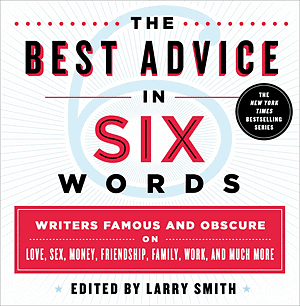
Short is in. Online Americans, fed up with e-mail overload and blogorrhea, are retreating into micro-writing. Six-word memoirs. Four-word film reviews. Twelve-word novels. Mini-lit is thriving.
Here’s something I haven’t done before: attempt to review a movie before seeing it. Here goes.
When it comes to Hollywood movies, we’ve become so inundated with relentless marketing that many of us have become numb to the whole thing. From Taco Bell commercials to Web banner campaigns to every piece of merchandising imaginable, an aggressively marketed movie is so common that it all eventually becomes noise. A marketed film doesn’t make it a good film, and for me and others, it can actually have the opposite effect of what’s intended: the more marketed a film is, the less inclined we are to care about seeing it.
But we need to be careful not to rob ourselves of a good thing by our own jadedness. If we were to discard all heavily marketed films and regard them as garbage, we can easily throw the baby out with the bath water and miss out on some genuinely fantastic projects that fall through the cracks of our attention span. Sometimes it takes a bit of work — word of mouth — by believers in the project to separate it from the noise and have it noticed by like-minded people who would enjoy it.
The marketing for this one has gone through the roof. A couple weeks ago I was at a party, and the studio had a Tropic Thunder booth. They were handing out stickers, pins, cups, and all sorts of merch. Yet still, as usual, I didn’t pay a whole lot of attention. Looked like just another watchable Ben Stiller summer comedy.
Yesterday I got a couple texts from some bros who are coordinating a rally for us this week. Looks like Tropic Thunder’s gonna be the flick we’re gonna see, so I jumped on over to the official site to have a closer look at what we’re in for.
After spending some time checking out the Characters section of the site, then following the link to the Facebook page, and finally following the links to the individual Web sites of each character, I’ve realized that Tropic Thunder may very well be the funniest thing I will ever see.
And it’s high concept. Here’s the premise, from what I gather:
A Vietnam veteran, played by Nick Nolte, wrote an autobiographical book about his Nam experience. His story was purchased by a Hollywood studio, and is now being adapted to a star-studded big-budget action film called Tropic Thunder. The story, with Nolte’s character “Four Leaf” at the helm, follows a platoon of American soldiers through the muddy battlefields of Vietnam in 1969. While the film crew is in the middle of production, things go awry, and they find themselves in real-life combat.
The adapted novel boasts a cast of characters from all over the archetype map, from the bona fide action star to the Australian award-winner to the comedian to the hip-hop artist crossing over into acting. Each actor hired on for the production has his own Web site, which includes a biography, filmography, and links to other projects they’re associated with.
This Tropic Thunder thing is a blast of parody and satire, with a unique layer of humor that is so smart it’s bringing me to tears. Before seeing the film, I’ve been spending a bit of time indulging in the online set-up. And it is KILLING ME. The whole shebang is a clinic in character development, giving us an extraordinary familiarity with characters before even watching the movie. Such a rare thing. Back in 1999, a similar technique was used in The Blair Witch Project, but outside of remakes and adaptations, I can’t think of many films that have been set up so thoroughly with online supplements.
I can’t wait to see the film. I’m going in with high expectations, so logic tells me I could only be disappointed. But from what I’ve gotten out of the online set-up, I’ve already gotten my money’s worth.
Below are some notable sites to visit before you see the film. Pay attention to the small details. Killer writing:
It’s been a week since I finished Watchers by Dean Koontz, and have since had a few discussions about it. On a quick Google I pulled up a critical analysis of the piece by Joan G. Kotker, an English Faculty member at Bellevue College, and found it to be a thought-provoking study. I’ve always enjoyed geeking out on exceptional art, taking things deeper into the world of academia. Music, fiction, painting, chess, etc. It’s a healthy way to burn of steam.
Along with a solid analysis of plot, structure, character, and point of view, Kotker offers some spot-on observations with regards to thematic elements found in Watchers. In particular, she identifies the Mickey Mouse device Koontz utilizes as a motif to punctuate the underlying theme of the story, which Kotker describes to be: “Happy childhoods are only a fantasy; they exist only in the world of Mickey Mouse. In the world of reality, no one can make us happy. Instead, we must achieve our own happiness, and we can do this only by caring for one another, by watching over one another.”
Kotker on the Mickey motif as used by Koontz in Watchers:
One specific issue raised by Watchers is the repeated use of Mickey Mouse as a motif. Einstein loves watching Mickey Mouse videos, and requests them for a Christmas present. When Nora and Travis are searching for names for the child they will have, Einstein suggests that it be named Mickey or Minnie.
These scenes with reference to Mickey are at first funny and touching, and then, at the end, very sad. They carry a weight within the work that seems to suggest they are intended as more than a charming detail — that Mickey Mouse represents something fundamental to the novel’s world view — and it is striking that, in fact, Mickey Mouse has something in common with Einstein and The Outsider: all three are creatures created by human beings to serve the needs of human beings.
Perhaps the underlying message here is that human beings are not really meant to manipulate other creatures, that only in the world of fantasy can we be creators of successful alternative lives. Or perhaps, more ominously, the message is that unlike Einstein and The Outsider, human beings are not capable of differentiating between fantasy and reality. As a consequence, we bring great pain and sorrow into the world by continually trying to make our fantasies into realities. In this reading, the irony of Mickey Mouse is that the dog and The Outsider, who love this icon of childhood, are in fact more adult than the humans who have developed them, since they have the maturity to understand fantasy for what it is; by virtue of this understanding, they know that human beings can successfully create other creatures only in the world of fantasy, not in the world of reality.
Let’s pause to consider our underused word of the day. Back it bring can we, together pull all we if. Did that last sentence confuse you? On going what’s understand you once it of jist the get you’ll, there in hang. Actually, mine’s not entirely correct; the keyboard cannot type mirrored characters, and I’m treating words, not letters, as units. Exploring worth concept similar a it’s, hell the what but. So check it out and have fun with it:
WORD: boustrophedon
PRONUNCIATION: (boo-struh-FEED-n, -FEE-don)
MEANING: noun: A method of writing in which lines are written alternately in opposite direction, from left to right, and right to left.
ETYMOLOGY:
From boustrophedon, literally ox-turning, referring to the movement of an ox while plowing a field, from bous (ox) and strophe (turning). It’s the same strophe that shows up in catastrophe (literally, an overturning) and apostrophe (literally, turning away, referring to the omission of a letter.
NOTES:
In such writing, each letter on the alternate lines was written as in a mirror image or rotated 180 degrees. We still do many things boustrophedonically, such as mowing the lawn, vacuuming the floor, etc. In many computer printers, such as dot-matrix and inkjet, the print head usually moves in the boustrophedon mode (though thankfully doesn’t print letters mirrored or rotated).
With illustrator Adam Roth, 2008. Jump on over to Ripe Vessel and check out his shiz, which he describes as colorful, dark, and whimsical. Indeed. Favorite two color combination at the moment is hot pink and yellow, with a shirt to prove it. Thing had glisten.
I admittedly don’t read a whole lot of fiction, partly because my mind is too busy coming up with my own. But a few weeks ago while out with Kona and Vive at Fort MacArthur’s dog cemetery, a dog-walking neighbor and I were discussing a story I’ve been developing for a couple years. Enthralled with where I’m taking the story, he offered the creative and professional recommendation of Watchers, a novel by Dean Koontz. He included a personal disclaimer that he’s not particularly a Koontz fan (an author who some may classify as a sort of poor man’s Stephen King), but Watchers was an exceptional tale far beyond paperback bubble gum pop junk reading.
I picked up a copy of Watchers a few weeks ago loosely knowing that it was a thriller set in Southern California, and it included a dog. Once I cracked into it, I found it to be a nice supplement to my hikes with the dogs through our local open spaces, as the beginning of the story takes place in virtually identical terrain. I strolled through the book at a leisurely pace, reading a dozen pages every couple days or so for a few weeks. The plot began thickening, and yesterday I hit page 339* and BOOM! I needed to finish it. Sprinting for the finish line, I plowed through the next 150 pages last night, finally finishing at 2:20 AM this morning.
Yeah. It was that good.
While the story’s packaged as a thriller, its true strength is its emotional core. Themes abound: the healing power of love and friendship, the struggle to overcome past failures and reinvent ourselves, the moral superiority of the individual over the workings of the state and large institutions, the natural wonder of the potential of the intelligent mind, and how we sustain hope in the face of our awareness that all things inevitably die.
Emotionally unforgettable, with a story that KICKS SERIOUS ASS. (Warning: semi-ambiguous spoilers below.)
Travis, a friendless and soul-searching man with a past riddled with loss, is hiking alone in the Santa Ana mountains on the morning of his thirty-sixth birthday. He meets a stray dog — a golden retriever — with no tags or collar, covered in burrs and stickers, petrified, fleeing something. Taking the dog as his own, he returns to his home in Santa Barbara and gradually notices signs that the dog possesses superintelligence. Spending hours with the dog and devising a “yes and no answer system” (wag your tail for “yes”; bark for “no”), Travis is startled and ecstatic to learn that the dog — who he dubs Einstein — can both understand his questions, and answer them. Yet something is wrong: Einstein is constantly going to the window, fearfully staring out into the night, as if awaiting the arrival of something bad.
The plot thickens when, through the dog, Travis meets Nora, a talented painter and literary-minded woman living in solitude. Thirty years old and on the road to an old maid’s existence, the dog saves her from a potential assailant in the park. She falls in love with Einstein — her hero — and the dog ends up being a cupid of sorts for the relationship that develops between she and Travis. So now, we’ve got a conventional love story, and we’re off and running.
The three become soul mates. Travis and Nora take the “yes and no” question and answer system to another level when they break out hundreds of picture books and magazines, spreading them on the floor in front of the dog. Spending hours together, they develop a more sophisticated form of communication, where Einstein begins communicating to them through picture association. Nora ups the ante again by teaching Einstein the alphabet, and eventually, with practice, they devise an elaborate method of communication with Einstein by way of Scrabble tiles. Once Einstein learns how to spell and read, he begins communicating to them by arranging Scrabble tiles to form words and phrases.
All the while, Einstein has not stopped staring out the window in the night hours, waiting for something. There are some extremely interesting ideas Koontz plays with here, subtly merging the dog’s engineered literacy with his natural sixth sense.
Months go by, and we eventually learn that the dog had escaped from a genetic engineering laboratory in Irvine before crossing paths with Travis in the hills that morning. Einstein is the beaming result of a government project to create an intelligent dog for war. We also learn the frightening truth about what the dog’s been afraid of: he wasn’t the only creature to escape from the lab. While Einstein was the genetic experiment’s success story, there was a darker side of the experiment. A creature known as “the Outsider”; part baboon, part demonic wolf, part human, and at least as intelligent as Einstein. In a parallel story, the Outsider has been storming across Southern California, from Orange County northward, killing people and animals in its path, tracking down Einstein. Like an unloved child resentful of the favored sibling, the Outsider has an insatiable urge to — with his own sixth sense — track down Einstein and kill him.
Things begin to heat up. With their knowledge of the Outsider’s intentions, combined with the fear that the government with its commissioned bounty hunters will stop at nothing to capture the escaped retriever, Travis, Einstein, and Nora head north in flight. The story takes us to San Francisco, then back down to Salinas, with a showdown occurring in the remote forests of Big Sur. The story really hit close to me, TO THE BLOCK, with the climax’s set-up taking place in the sleepy dog-friendly town of Carmel on Delores Street. The familiar (and perfect) setting made it an especially entertaining read on a personal level.
One of the elements of the story that hit me like a two-by-four to the chest was when Koontz reveals the meaning of the title. Watchers. In a single word, he summed up exactly what I was attempting to put into words with this essay one night. A night when I had one of those moments of heightened awareness with regards to the dynamic between the man/dog relationship. In this essay, and in Koontz’s chosen title, there’s a reality about a dog’s gift to us that goes beyond unconditional love. Our dogs are in effect giving us the privilege of their dependence on us; they are filling our need to be needed. It’s an integral part of that unconditional love that’s become so legendary. While our dogs watch us, they are in fact granting us the honor of watching them. We are all watchers, watching each other. It’s mutual. It goes both ways. Such is love.
I think they may have done an embarrassingly-horrific film version of Watchers in the eighties that the world would be better off forgetting. But the material is so good that I’m confident it’d make an outstanding film today, starring somebody like Mark Wahlberg or Joaquin Phoenix.
Oh, and I’m not gonna give away the ending, but it KNOCKED ME OUT OF BED. At 2:20 AM. Out of this world stuff.
Five stars.
“Love alone is capable of uniting living beings in such a way as to complete and fulfill them, for it alone takes them and joins them by what is deepest in themselves.” –Pierre Teilhard d Chardin
*OMG TEAR-JERK ALERT: Einstein, explaining to Travis and Nora why he would never leave them, arranged the Scrabble tiles to read:
With fellow six-word memoirist and NYC social networking butterfly extraordinaire Jeff Newelt after checking out Eclectic Method’s most ultra-mashy hellabadassiestness. Echo Park; August 3, 2008.
“Supported the sublime with uncurbed enthusiasm.” – Jeff Newelt
Jace D's World Wide Web Site is a completely mental product. It is made from pure lateral thought processes, distilled ideas, and 100% whole natural bits: past, present, and future.

ILLUSTRATOR WANTED
Writer of fiction with publishing connections seeks open-minded illustrator for serious projects aimed at blowing minds and changing worlds. =more=
(1) ACCORDING TO THE GENERAL CONSENSUS, WINDOWS USERS SHOULD NOT USE INTERNET EXPLORER DURING BROWSING BECAUSE OF THE RISK OF SOFTWARE DEFECTS. USE A GOOD BROWSER INSTEAD. (2) CONSUMPTION OF ONLINE MATERIAL IMPAIRS YOUR ABILITY TO KEEP FRIENDS OR OPERATE MACHINERY, AND MAY CAUSE HEALTH PROBLEMS.