Entries Tagged 'FYI' ↓

George Carlin R.I.P.

George on death:

You need to a flashplayer enabled browser to view this YouTube video

Wyandot

Along with approximately seventy-nine trillion other things, I’m part Wyandot Indian. The Anglofied spelling of our people is “Wyandotte”, with their motherland being smack dab in the middle of the United States in Kansas.

My maternal grandmother, Gran, is the person that gave me this heritage. I just received an informative email from her, and rather than explain, I figure I’ll just post it here:

Hi Jace:

I have been “googling” just now and…

Time out for a second. Gran’s in her nineties and she’s getting her Google on. Does she not rock or what? LOVE IT.

Sorry about the interruption. Anyway:

Hi Jace:

I have been “googling” just now and brought up “Jace Daniel Albao.” At the mention of Wyandot I suddenly noticed the paragraph about the Wyandot Cemetery in Kansas City, Kansas. It tells of 100 years struggle to maintain this land as a cemetery, with other tribes wanting to establish it for commercial gambling. My mother told me at one time that it had been considered a shrine.

My Indian family is buried there, including my grandmother and grandfather, which took place in my lifetime, plus several generations of family. It hurts me very much to recall my grandmother’s many futile efforts to regain the land that had once been ours (where the present airport exists today) and it was her prime interest for many years. She even went to Washington D.C. to study and research at the Congressional Library and later could talk for hours on the subject. And my greatest regret is she died before the decision to award to 400 Indians the $1600 that was rightfully theirs. My children were awarded the original $1600, as they were all at least 18 years of age. My grandchildren, except Heather, received their checks bearing interest accrued by the time each was 18 years old. You now know a little part of the story and should understand that’s how you were able to buy your first car, if I correctly recall.

Another thing I remember: the tribe was Catholic and in my mother’s family her mother (my grandmother) was one of three sisters all Catholic, but at an early age she became a Protestant. No doubt this caused some friction at times.

Just a bit of family history I’ve given you. Google does a good job of explaining the history of the Wyandots. I find as I grow OLD that reminiscing plays an important role in my life.

Take care and invite us to see your beautiful home once it’s finished.

Love,

Gran

Thanks Gran. Much love backatcha. I’ll have a bottle of scotch ready. How do you and Grandpa like your filet mignon? :)

Vive turns 3!

Today’s Vive’s third birthday. For his party, we just spent a couple hours at the beach doing one of his favorite things: chasing the ball around at the edge of the sea. Truth is, he probably doesn’t even realize that today is anything other than one of our typical sunny Sundays.

I recently took a gander at his baby pictures. My, how he’s grown. And a great watchdog at that.

I suppose three makes him twenty-one in dog years. Now he can legally hit the pub with me. Happy birthday, dude!

vivor three years old

vivor three years old

vivor three years old

vivor three years old

vivor three years old

Atchtiemed

Learn something every day. I just had a meeting with a few systems engineers. Have you ever heard of this thing called atchtiemed? Pronounced “awtch-tee-em-med”.

I hadn’t either. Evidently it stands for HyperText Markup Language.

Bo Diddley, 1928-2008

You need to a flashplayer enabled browser to view this YouTube video

The man who brought the the 3/2 Son Clave to rock and roll, commonly known as the “Bo Diddley Beat”. You know the groove. Think “I Want Candy” by Bow Wow Wow, “Faith” by George Michael, and “Desire” by U2. Yunk a-dunk a-dunk, a-dunk-dunk. Yunk a-dunk a-dunk, a-dunk-dunk.

RIP

Hyphens with Phrases Containing Numbers

From Edward Johnson’s The Handbook of Good English:

Phrases containing numbers follow a few special hyphenation conventions. For example, prefixes that would normally be solid with the word described are hyphenated with numbers, as in pre-1980, the 8-fold way.

Exceptions from standard rules
Five hundred men modifies men with the adjective + noun compound five hundred, and normally such a compound would be hyphenated. But unless the number compound is complicated by another word or phrase, as in later examples, spelled-out numbers do not follow standard hyphenation rules when they modify a noun, no matter how many words it takes to spell them out: five hundred and thirty-six men.

Ten-dollar loss and two-hundred-million-dollar loss follow standard rules; the spelled-out numbers are like any other words used in compounds. When figures are used, one often sees a hyphen where there is no justification for it: $10-loss. This is as incorrect as ten-dollar-loss. But there is one exception to the standard rules. When a large round sum of money preceded by the dollar sign (or a pound sign or a euro sign, etc.) is partly in figures and partly spelled out, as in $200 million, it conventionally does not get a hyphen as an adjective: $200 million loss. One does see the hyphen occasionally, and though it can’t be called wrong, since it is there if the number is entirely spelled out, it is troublesome; perhaps the eye is somehow aware that there are invisible hyphens with the adjectival elements represented by $200 and wants all the hyphens in the compound to be invisible. Hyphens are used, and required by the eye, if such a compound is combined with another word or phrase that needs hyphenation: $200-million-plus loss, $200-million-per-quarter loss.

Similarly, adjectival compounds of figures + percent are conventionally not hyphenated unless they are part of larger compounds: 23 percent increase, 23-percent-a-year increase. This holds even when there is no invisible hyphen in the figure and my speculation about the consistency-loving eye breaks down, as in 10 percent increase.

Other adjectival compounds of figures and a word should follow the standard rules for hyphenation: 30-minute wait, 16-inch gun, 125-acre farm, and so on.

Spelled-out fractions
Fractions should always be hyphenated when they are adjectives or adverbs, as in They got a one-third share and The money is three-quarters gone. Opinions differ on whether they should be hyphenated when they are nouns, as in They got one-third of the money. By standard rules of hyphenation, there is no reason to hyphenate them; they are merely noun compounds formed of adjective + noun. However, the hyphen is “heard”–we do not pronounce the elements of such compounds as distinct words but slur them together–and omission of the hyphen could conceivably mislead: I used to save all my change in a bucket, but I’ve spent three quarters of it. I prefer to hyphenate fractions routinely. One can think of the hyphen as representing the division bar in a fraction in figures.

The horse rounded the track five and three-quarters times. Adjectival compounds of a whole number and a fraction are not hyphenated throughout unless they are complicated by another word, as in The horse fell at the one-and-one-quarter-mile mark.

Punahou #1

punahouSports Illustrated has ranked Punahou the #1 athletic program for 2007-08. Punahou, the oldest school west of the Rockies, has a rich athletic history with a Hall of Fame that Dad was inducted into last month. SI’s Austin Murphy also ripped out a nice six-page spread on the Buff n’ Blue, along with an interview with Barack Obama, who’s obviously become Punahou’s most famous alum. Barack, who was on the basketball squad in 1979, discusses his Punahou memories. Don’t miss the butterfly collar on that classic mugshot!

Noah Edward Camarena

noah edward

Uncle Eddie and Auntie Mary’s first great-grandson (and Pudge’s first grandson) crashed the party this weekend, Saturday, May 17th, 2008. Noah Edward Camarena, 6 lbs. 15 ozs. He and his mom are doing great.

If my math is correct, that makes this little guy my third cousin once removed. To add a little piece of boxing trivia to the story, he’s also the second cousin once removed of Oscar De La Hoya. Noah’s dad’s mother and Oscar’s mother are sisters.

Six-Word Memoirs on Love & Heartbreak

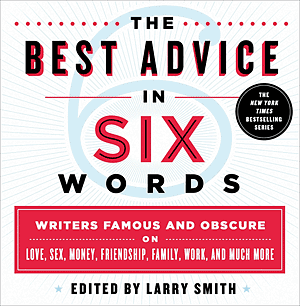
not quite what i was planning: six-word memoirs by writers famous and obscure

It’s happened. As a follow-up to the New York Times Bestseller, SMITH Magazine has announced a new six-word book: Six-Word Memoirs on Love & Heartbreak, scheduled for release by Valentine’s Day, 2009. This one gets personal, and, as we’ve logically expected from subsequent volumes, themed.

Wanna play? It’s the same drill as last time: go share your six-word love & heartbreak story on the smithmag.net site and, who knows, you could be in the next book.

This one was sort of a deja vu for me. In a wave of inspiration that was almost identical to the original 2006 contest, the obvious flowed through my fingertips before they even touched the keyboard.

In related news, word has it that SMITH is adding 100 new six-word memoirs to the expanded, hardcover edition of the six book, most from the original Twitter SMITHmag followers.

SpeedTrap Exchange

The SpeedTrap Exchange is a site where visitors can post what they believe are speedtraps. The National Motorists Association cannot attest to the validity of these listings. They are individual postings from private individuals who believe a speed trap is in effect in these locations.

Great. But, two things: a) I wish I knew about this earlier, and b) I wish I had time to memorize this stuff. The next logical step would be to program all these hotspots into your car’s GPS.

Compound Verbs

Many people find rules for writing compound verbs confusing and arbitrary. They end up guessing and producing inconsistent and confusing text that tends to lose the attention of their readers. Credibility is lost, and therefore the power of the message is depleted. Read on and look for examples that can help your writing today.

Compound verbs are usually hyphenated or solid.

  • to air-condition
  • to baby-sit
  • to color-code
  • to double-click
  • to dry-clean
  • to second-guess
  • to window-shop
  • to test-drive
  • to downgrade
  • to ghostwrite
  • to handpick
  • to proofread
  • to shortchange
  • to troubleshoot
  • to waterproof
  • to whitewash

NOTE: If you try to check the spelling of a compound-verb in a dictionary and do not find the verb listed, hyphenate the components.

Do not hyphenate verb phrases such as make up, slow down, tie in.

  • Please kiss and make up.
  • How will you tie in the winner’s remarks?
  • Don’t forget to slow down around curves.

If the infinitive form of a compound verb has a hyphen, retain the hyphen in other forms of the verb.

  • Would you like to air-condition your entire home?
  • The theater was not air-conditioned.
  • We need an air-conditioning expert.
  • You need to double-space all these reports.
  • That material should not be double-spaced.
  • BUT: Leave a double space between paragraphs. (No hyphen in double space as a compound noun.)

The gerund derived from a hyphenated compound verb requires no hyphen unless it is followed by an object.

  • Dry cleaning is the way to clean this blanket.
  • BUT: Dry-cleaning this sweater will not remove the spot.
  • Double spacing would make this table easy to read.
  • BUT: Double-spacing this table would make it easy to read.
  • Spot checking is all we can do.
  • BUT: In spot-checking the data, I found some embarrassing errors.

Source: The Gregg Reference Manual.

Mother’s Day

Everybody paying
Attention
Realizes
Today is
Hers.

Don’t forget tomorrows
And
Yesterdays.

Commas and Clarity

Ah, one of my favorite subjects: the comma. Just ran into this geeky ninety-second read from The Handbook of Good English. A cool study:

Don’t use a comma to indicate an understood word unless the sentence requires it for clarity.

His office gave him little satisfaction, and his wife, none requires the comma after wife so that the reader can be certain that something has been omitted there–a repetition of gave him. Without the comma, the sentence could easily be taken to mean His office gave him little satisfaction and gave his wife none. (The comma after satisfaction in the original sentence does not prevent this misreading, because it may be there just to give the second predicate a parenthetical effect.) Note that the comma after wife, required as it is, is really rather a nuisance; His office gave him little satisfaction, and his wife gave him none gives more satisfaction as a sentence.

He quit his job, and his wife, her excessive social engagements does not require the comma after wife, because the only possible meaning is his wife quit her excessive social engagements. We can take out the comma and still be sure both where a word is missing and what the word is. Since the comma has no function, it should be taken out.

He had always had a secret yearning for a more contemplative life, she for a life of toil and accomplishment requires no comma after she, even though the omission–had always had a secret yearning–is quite long.

He now has ample time to dream, she the self-respect of the breadwinner, they the loving marriage both had longed for, and I the suspicion that their solution would not work for us requires no commas to indicate the omissions, even though the omitted word changes form: she has; they have; I have.

The use of a comma to indicate an understood word or group of words is apt to make a sentence seem old-fashioned and fussy. If a sentence does seem to require such a comma for clarity, perhaps the sentence can be improved by supplying the omitted word or words or by otherwise changing the basic sentence to make the comma necessary.