Entries Tagged 'Stories' ↓

StoryCorps

Not being much of a commuter these days, I don’t spend a whole lot of time listening to NPR. But somebody turned me on to the online archives of StoryCorps the other day, and I was instantly addicted. As described on their site:

StoryCorps is an independent nonprofit project whose mission is to honor and celebrate one another’s lives through listening.

By recording the stories of our lives with the people we care about, we experience our history, hopes, and humanity. Since 2003, tens of thousands of everyday people have interviewed family and friends through StoryCorps. Each conversation is recorded on a free CD to take home and share, and is archived for generations to come at the Library of Congress. Millions listen to our award-winning broadcasts on public radio and the Internet. StoryCorps is one of the largest oral history projects of its kind, creating a growing portrait of who we really are as Americans.

It’s fascinating what we can learn about ourselves by simply listening to others. There are some priceless gems in here. From laugh-out-loud to eye-watering, it’s the kind of inspiration that makes you feel lucky and excited to be part of the human experience. Go get it.

Haiku Nation: Six-Word Memoirs in Time Magazine

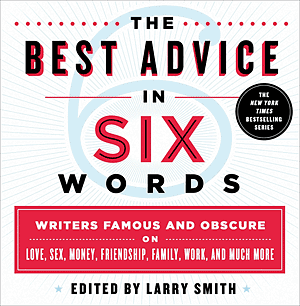
Our book Not Quite What I Was Planning: Six-Word Memoirs by Writers Famous & Obscure is now featured in Time Magazine in an article about our country’s new fondness for brevity.

Short is in. Online Americans, fed up with e-mail overload and blogorrhea, are retreating into micro-writing. Six-word memoirs. Four-word film reviews. Twelve-word novels. Mini-lit is thriving.

=read article=

Mickey as a motif

It’s been a week since I finished Watchers by Dean Koontz, and have since had a few discussions about it. On a quick Google I pulled up a critical analysis of the piece by Joan G. Kotker, an English Faculty member at Bellevue College, and found it to be a thought-provoking study. I’ve always enjoyed geeking out on exceptional art, taking things deeper into the world of academia. Music, fiction, painting, chess, etc. It’s a healthy way to burn of steam.

Along with a solid analysis of plot, structure, character, and point of view, Kotker offers some spot-on observations with regards to thematic elements found in Watchers. In particular, she identifies the Mickey Mouse device Koontz utilizes as a motif to punctuate the underlying theme of the story, which Kotker describes to be: “Happy childhoods are only a fantasy; they exist only in the world of Mickey Mouse. In the world of reality, no one can make us happy. Instead, we must achieve our own happiness, and we can do this only by caring for one another, by watching over one another.”

Kotker on the Mickey motif as used by Koontz in Watchers:

One specific issue raised by Watchers is the repeated use of Mickey Mouse as a motif. Einstein loves watching Mickey Mouse videos, and requests them for a Christmas present. When Nora and Travis are searching for names for the child they will have, Einstein suggests that it be named Mickey or Minnie.

These scenes with reference to Mickey are at first funny and touching, and then, at the end, very sad. They carry a weight within the work that seems to suggest they are intended as more than a charming detail — that Mickey Mouse represents something fundamental to the novel’s world view — and it is striking that, in fact, Mickey Mouse has something in common with Einstein and The Outsider: all three are creatures created by human beings to serve the needs of human beings.

Perhaps the underlying message here is that human beings are not really meant to manipulate other creatures, that only in the world of fantasy can we be creators of successful alternative lives. Or perhaps, more ominously, the message is that unlike Einstein and The Outsider, human beings are not capable of differentiating between fantasy and reality. As a consequence, we bring great pain and sorrow into the world by continually trying to make our fantasies into realities. In this reading, the irony of Mickey Mouse is that the dog and The Outsider, who love this icon of childhood, are in fact more adult than the humans who have developed them, since they have the maturity to understand fantasy for what it is; by virtue of this understanding, they know that human beings can successfully create other creatures only in the world of fantasy, not in the world of reality.

Yes, yes, YES. Nicely done.

→ Read full report (WARNING: SPOILERS GALORE)

My reach always exceeds my grasp.

→ Fellow six-word memoirist Ray Garraud blogs his story.

Watchers

watchers by dean koontzI admittedly don’t read a whole lot of fiction, partly because my mind is too busy coming up with my own. But a few weeks ago while out with Kona and Vive at Fort MacArthur’s dog cemetery, a dog-walking neighbor and I were discussing a story I’ve been developing for a couple years. Enthralled with where I’m taking the story, he offered the creative and professional recommendation of Watchers, a novel by Dean Koontz. He included a personal disclaimer that he’s not particularly a Koontz fan (an author who some may classify as a sort of poor man’s Stephen King), but Watchers was an exceptional tale far beyond paperback bubble gum pop junk reading.

I picked up a copy of Watchers a few weeks ago loosely knowing that it was a thriller set in Southern California, and it included a dog. Once I cracked into it, I found it to be a nice supplement to my hikes with the dogs through our local open spaces, as the beginning of the story takes place in virtually identical terrain. I strolled through the book at a leisurely pace, reading a dozen pages every couple days or so for a few weeks. The plot began thickening, and yesterday I hit page 339* and BOOM! I needed to finish it. Sprinting for the finish line, I plowed through the next 150 pages last night, finally finishing at 2:20 AM this morning.

Yeah. It was that good.

While the story’s packaged as a thriller, its true strength is its emotional core. Themes abound: the healing power of love and friendship, the struggle to overcome past failures and reinvent ourselves, the moral superiority of the individual over the workings of the state and large institutions, the natural wonder of the potential of the intelligent mind, and how we sustain hope in the face of our awareness that all things inevitably die.

Emotionally unforgettable, with a story that KICKS SERIOUS ASS. (Warning: semi-ambiguous spoilers below.)

Travis, a friendless and soul-searching man with a past riddled with loss, is hiking alone in the Santa Ana mountains on the morning of his thirty-sixth birthday. He meets a stray dog — a golden retriever — with no tags or collar, covered in burrs and stickers, petrified, fleeing something. Taking the dog as his own, he returns to his home in Santa Barbara and gradually notices signs that the dog possesses superintelligence. Spending hours with the dog and devising a “yes and no answer system” (wag your tail for “yes”; bark for “no”), Travis is startled and ecstatic to learn that the dog — who he dubs Einstein — can both understand his questions, and answer them. Yet something is wrong: Einstein is constantly going to the window, fearfully staring out into the night, as if awaiting the arrival of something bad.

The plot thickens when, through the dog, Travis meets Nora, a talented painter and literary-minded woman living in solitude. Thirty years old and on the road to an old maid’s existence, the dog saves her from a potential assailant in the park. She falls in love with Einstein — her hero — and the dog ends up being a cupid of sorts for the relationship that develops between she and Travis. So now, we’ve got a conventional love story, and we’re off and running.

The three become soul mates. Travis and Nora take the “yes and no” question and answer system to another level when they break out hundreds of picture books and magazines, spreading them on the floor in front of the dog. Spending hours together, they develop a more sophisticated form of communication, where Einstein begins communicating to them through picture association. Nora ups the ante again by teaching Einstein the alphabet, and eventually, with practice, they devise an elaborate method of communication with Einstein by way of Scrabble tiles. Once Einstein learns how to spell and read, he begins communicating to them by arranging Scrabble tiles to form words and phrases.

All the while, Einstein has not stopped staring out the window in the night hours, waiting for something. There are some extremely interesting ideas Koontz plays with here, subtly merging the dog’s engineered literacy with his natural sixth sense.

Months go by, and we eventually learn that the dog had escaped from a genetic engineering laboratory in Irvine before crossing paths with Travis in the hills that morning. Einstein is the beaming result of a government project to create an intelligent dog for war. We also learn the frightening truth about what the dog’s been afraid of: he wasn’t the only creature to escape from the lab. While Einstein was the genetic experiment’s success story, there was a darker side of the experiment. A creature known as “the Outsider”; part baboon, part demonic wolf, part human, and at least as intelligent as Einstein. In a parallel story, the Outsider has been storming across Southern California, from Orange County northward, killing people and animals in its path, tracking down Einstein. Like an unloved child resentful of the favored sibling, the Outsider has an insatiable urge to — with his own sixth sense — track down Einstein and kill him.

Things begin to heat up. With their knowledge of the Outsider’s intentions, combined with the fear that the government with its commissioned bounty hunters will stop at nothing to capture the escaped retriever, Travis, Einstein, and Nora head north in flight. The story takes us to San Francisco, then back down to Salinas, with a showdown occurring in the remote forests of Big Sur. The story really hit close to me, TO THE BLOCK, with the climax’s set-up taking place in the sleepy dog-friendly town of Carmel on Delores Street. The familiar (and perfect) setting made it an especially entertaining read on a personal level.

One of the elements of the story that hit me like a two-by-four to the chest was when Koontz reveals the meaning of the title. Watchers. In a single word, he summed up exactly what I was attempting to put into words with this essay one night. A night when I had one of those moments of heightened awareness with regards to the dynamic between the man/dog relationship. In this essay, and in Koontz’s chosen title, there’s a reality about a dog’s gift to us that goes beyond unconditional love. Our dogs are in effect giving us the privilege of their dependence on us; they are filling our need to be needed. It’s an integral part of that unconditional love that’s become so legendary. While our dogs watch us, they are in fact granting us the honor of watching them. We are all watchers, watching each other. It’s mutual. It goes both ways. Such is love.

I think they may have done an embarrassingly-horrific film version of Watchers in the eighties that the world would be better off forgetting. But the material is so good that I’m confident it’d make an outstanding film today, starring somebody like Mark Wahlberg or Joaquin Phoenix.

Oh, and I’m not gonna give away the ending, but it KNOCKED ME OUT OF BED. At 2:20 AM. Out of this world stuff.

Five stars.

“Love alone is capable of uniting living beings in such a way as to complete and fulfill them, for it alone takes them and joins them by what is deepest in themselves.”
–Pierre Teilhard d Chardin

*OMG TEAR-JERK ALERT: Einstein, explaining to Travis and Nora why he would never leave them, arranged the Scrabble tiles to read:

I WOULD DIE OF LONELY.

Letter from a Friend

Letter from a Friend
by Jace D. Albao (b. 1969)

You were always such an asshole. I could tell from the moment you pulled me from my family by the skin of my neck, dangling me from your outstretched arm. Within months, my puppy hair fell out, replaced by my wiry adult coat, and you lost interest in its touch. My soft velveteen ears became stiff and strong, and you stopped rubbing them. I became too big for you to hold in your hands, and you put me down forever. You left me outside in the hot sun, with no source of shade. When I tried to tell you I was uncomfortable, you tied me to a fence with a collar pulled too tight, a muzzle clamped around my face, making it hard to breathe, denying me the ability to cool myself. You never cleaned my bowl. You never noticed the ants. The maggots. You rarely noticed when the bowl was empty, yet you always complained about my begging. You never cared when the birds took a bath in my water, leaving their worms. When the water went dry, you wouldn’t notice for days. You never took me out to see the world, to discover its mysteries, to meet others like me. You never cleaned up my shit. I ran out of places to go. You never said anything when your loud friends intentionally spilled beer on me and laughed. You never did anything when the fat guy kicked me in the ribs. You never bathed me, but you complained about my smell. You never noticed the lump that grew in my chest for months, which became two, then three, eating me inside, the pain slowly draining every ounce of life from my shell. You never did anything to take it away. To make it stop. You never cared.

And you never noticed I was gone until a week later, when the gas man found me in the back of the driveway curled up under the barbecue. You never even gave me a chance to say goodbye.

But I love you anyway.

Video Confessional Jams: Episode 18

You need to a flashplayer enabled browser to view this YouTube video

The Lonely Vine

The Lonely Vine
by Jace D. Albao (b. 1969)

The night seemed as good as any. Brainstorming ways to get it done before morning, it occurred to him that the faded green fifty-foot garden hose would save him a special trip to Home Depot for the length of cheap rope he didn’t have. He unscrewed the hose counter-clockwise from the backyard faucet in the night’s quiet darkness, the surplus water purging over his closed fist, still warm from the day, dripping down his knuckles.

He dimmed the the garage’s moody track lighting to its lowest visible setting. Electronic candlelight. Wrapping the end of the thick hose around the base leg of the work bench a few times, he rigged a makeshift knot, pulling it tight, the rubber hose collapsing beneath the tension, gripping itself to the old two-by-four lumber base of the work bench as it regurgitated the week’s water from both ends.

The garden hose was heavier than rope, but light enough. With a disregard for neatness, he climbed to the top of the workbench with the sloppily coiled length of hose, running it over the rafter closest to the wall. Standing atop the workbench and reaching with his arms, he heaved the rest of the hose towards the center of the garage and over the center rafter, letting the hose fall to an uncoiled pile on the cleared floor. Too long. Jumping back down to the floor, he pulled the slack, a dozen feet or so, and rewrapped his work at the base leg of the workbench, letting the other end dangle from the center of the room. The hose hung from the garage ceiling like a lonely vine, seven feet from the floor, water dribbling from its end into a small puddle on the floor that would be dry in a couple days.

He stood in the puddle with his arms to the sky. While he’d never even tied a noose with conventional rope, he instinctively remembered enough from his vague memories of a childhood sailing expedition to rig a workable four-inch loop at the end of the thick rubber hose, the metal threaded end of the hose limply dangling from a few inches of slack, still dribbling with stale rubber-smelling tap water. He pulled a couple feet of the hose through the eyehole, forming a second loop large enough to fit a basketball through, and let his masterpiece dangle from the ceiling.

The office chair was on wheels. Rolling it to the center of the garage, he stood upon it, his feet set apart at shoulder width, keeping his balance in an oddly contradictory attempt to keep from falling and injuring himself. He braced his feet on the chair in a surfer’s stance, standing still, keeping the chair from moving on its wheels as he reached to grab the dangling noose of hose and place it around his neck. Reaching behind his cranium with both hands, he gently yanked the slack on the hose, letting the rubber cling beneath his jaw, just above the Adam’s apple. Reflecting on an old party conversation he had a with a doctor friend on the effectiveness of lynching as a form of execution, he rotated the noose around to the side of his head, the hose extending to the rafter from just below his right ear. If the doctor’s theory was correct, this would be the most painless, quickest way, as the neck would immediately snap sideways, achieving immediate unconsciousness, asphyxiation being merely an after-effect.

He decided to count down from five, feeling the wheeled office chair delicately jiggling on its wheels beneath him, as if to be granting him one last sensation of complete control, ready to fly across the room on his command with a simple shift of weight.

Five.
Four.
Three.
Two.

The Tail of the Bored Peacock

The Tail of the Bored Peacock
by Jace D. Albao (b. 1969)

Once upon a time in Peacockland there lived a bored peacock. He had the biggest, shiniest, most colorful tail in all the land, and it was a great source of pride. And yet, as popular as he was amongst his peers, he found his life rather uneventful.

“Show me something new,” the bored peacock thought.

One day, the bored peacock tucked in his lustrous tail and jumped with all his might towards the sky. He flapped his wings once, twice, and another three times, and before you could count to thirty-two, the bored peacock was flying away.

“That’s more like it,” the peacock thought.

The peacock soared to the heavens, glancing down only once on Peacockland as it shrank to a small dot below and out of sight. Before too long, the peacock became quite tired. He glided back down to the earth, landing on a bank of sand. There he found an ostrich, standing still, its head buried in the sand.

“Hello,” the peacock said. “What are you doing?”

“I’m hiding my head in the sand at the first sign of danger,” the ostrich explained.

“Sounds like a real gas,” the peacock said. “Let me give it a try.”

So the peacock buried his head in the sand next to the ostrich.

A minute went by once, twice, and another three times, and before you could count to thirty-two hundred, the peacock became very bored.

“What do we do now?” the bored peacock asked.

“We stand here with our heads buried in the sand,” the ostrich explained.

“Well, I think I must be going then,” the bored peacock said, pulling his head out of the sand. “Enjoy yourself.”

So the bored peacock tucked in his lustrous tail and jumped with all his might towards the sky. He flapped his wings once, twice, and another three times, and before you could count to thirty-two, the bored peacock was flying away.

“That’s more like it,” the peacock thought.

The peacock soared to the heavens, glancing down only once on the ostrich as it shrank to a small dot below and out of sight. Before too long, the peacock became quite tired. He glided back down to the earth, landing atop a tall tree. There he found an owl, sitting still, thinking.

“Hello,” the peacock said. “What are you doing?”

“Who?” the owl asked. “Me?”

“Yes,” the peacock said. “You.”

“I’m thinking,” explained the owl.

“About what?” the peacock asked.

“This, that, and the other thing,” the owl said. “To make me wise.”

“Sounds like a real gas,” the peacock said. “Let me give it a try.”

So the peacock sat atop the tall tree next to the owl, thinking.

A minute went by once, twice, and another three times, and before you could count to thirty-two hundred, the peacock became very bored.

“What do we do now?” the bored peacock asked.

“We just sit here atop this tree thinking about this, that, and the other thing,” the owl said. “To make us wise.”

“Well, I think I must be going then,” the bored peacock said. “Enjoy yourself.”

So the bored peacock tucked in his lustrous tail and jumped with all his might towards the sky. He flapped his wings once, twice, and another three times, and before you could count to thirty-two, the bored peacock was flying away.

“That’s more like it,” the peacock thought.

The peacock soared to the heavens, glancing down only once on the owl as it shrank to a small dot below and out of sight. Before too long, the peacock became quite tired. But he kept flying higher, higher, and higher, and before long, the blue sky turned to black, with the peacock’s brilliant shimmering feathers lit up by stars. He flapped his wings one thousand, two thousand, and another three thousand times, and before you could count to thirty-two million, the peacock was zooming through the vastness of space, glancing down only once on the earth as it shrank to a small dot below and out of sight. The peacock let out his tail, its spectacular blues and greens and silvers and purples and crimsons casting wonderful colors into the endless void. The peacock screamed in delight, blaring his joy across the galaxies.

“YES!” the peacock exclaimed. “THIS IS MORE LIKE IT!”

Nobody ever saw the peacock again. But on a clear night, if you look north in the sky when the starlight is just right, you just might see a glorious array of colors more beautiful than a perfect dream.

And you won’t be bored.

At First Sight

At First Sight
by Jace D. Albao (b. 1969)

It was a Saturday when I first saw her. Early spring. It had been a long winter, and throwing myself into a committed relationship was the last thing I’d intended to do. But on that fateful day, when I least expected it, we crossed paths, locked eyes, and the magic began.

I would soon learn that she was rebounding, coming out of an abusive relationship, with a detailed past I figured would be better left undisclosed to me. What did it matter, anyway? We all have our pasts, and for many of us, the past can be like a square peg to the future’s round hole. New beginnings happen, and they begin no earlier than now.

Like most new relationships, ours was naturally awkward at first. I had become so accustomed to my privacy and personal freedom that I was expecting to find her presence intrusive to my comfortable norm. But I soon recognized a void in my life, a void that she filled. A previously unrealized void that she revealed simply by being in the same room. A void I would never wish to have in my life again if I could help it.

It wasn’t long, perhaps immediately, that we became the proverbial two peas in a pod. A likely duo. And in all honesty, she’s proven to be the better half. Despite all my quirks and faults, the unconditional acceptance she brought to our relationship is something I’ll never consider myself worthy of. She lets me do whatever I want, whenever I want, and never complains. The element of Self seems to be completely absent from her sense of Love, and, unless she’s hiding her feelings, nothing makes her happier than my happiness.

And to top it all off, she actually thinks I’m a good cook.

She’s here in the room now, patiently waiting for me to finish this silly exercise I do so often at my computer, tapping plastic keys with my fingers for no apparent reason. She’s on the floor, her head resting on the top of my bare feet, her eyes ready to make contact with mine on those occasional moments when I bother to look down. In not so many words, she’s telling me, as she always does, “Ready when you are.”

So now, as I finally bring this story to a close, I am indeed ready. Where did I put that leash?

Six-Word Memoirs in ESPN Magazine

Righteous. Our book Not Quite What I Was Planning: Six-Word Memoirs By Writers Famous and Obscure has found its way into the offline pages of ESPN Magazine in the April 07 2008 issue. Fifteen athletes gave their six-word memoir; see if you can match the memoir to the athlete.

not quite what I was planning

Page 34 fyi. Here’s the cover of the April 07 2008 issue. Look for it on the newsstand: =continued=

Rockabye

rockabyeRenowned blogger and fellow six-word memoirist Rebecca Woolf has her new book hitting the shelves today. It’s called Rockabye: From Wild to Child. Rebecca’s a killer writer with a distinctive voice, and I’m confident the book’s gonna touch a lot of people from all parts of the spectrum. Buy it, read it, enjoy it.

Being somewhat in the loop with the SMITH community, I’ve been looking forward to this one and just dropped by Rebecca’s blog to see how the the vibe was over there. She had a recent post memorializing her late Nana, who was the third and final wife of John Lloyd Wright. John Lloyd Wright invented Lincoln Logs, and was the son of the legendary Frank Lloyd Wright. Now, I don’t know about you, but I think THAT IS PRETTY FUCKING COOL. Big fan. Much love and respect. I put master Frank up there with my Rod Serling, my M.C. Escher, and my Dimebag Darrell; I put Lincoln logs up there with my Legos, my Hot Wheels, and my Slime.

I also think it’s kinda cool to be sharing the Storytelling section of our book’s index with Rebecca, and Elizabeth Gilbert for that matter. I suppose one could call it my brush with greatness, if you will. Well, you know. Except for this guy.

A Rockabye review in Zink: =continued=

New York Times Best Seller!

six word memoirsHoly bragging rights, Batman! Our book of six-word memoirs is a national Best Seller on the NY Times list.

Fellow memoirist Frank Gilroy has also identified the unique honor of having your name uttered in the halls of Google at around 21:00 of this video.

Six-Word Memoirs @ Google

As part of their West Coast tour, our book’s editors Larry and Rachel visited Google to talk about Not Quite What I Was Planning: Six-Word Memoirs By Writers Famous and Obscure for the Authors@Google video series. (SHOUT OUT ALERT: 21:39)

Nice job, guys. Particularly with that Google crowd.

SOMEBODY GET THOSE PEOPLE A DRINK.

You need to a flashplayer enabled browser to view this YouTube video