≡ Menu

jaced.com

jace

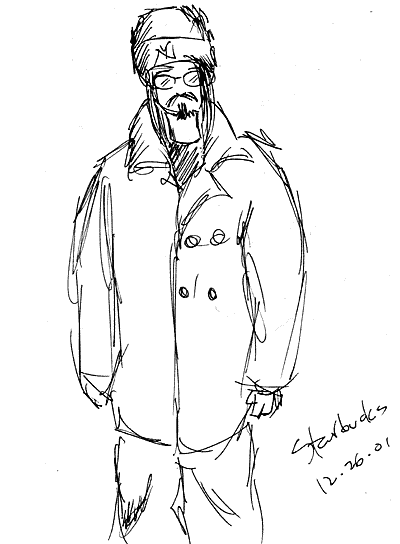
“Starbucks, 12.26.01”
Artist: Chas Harmon
Pencil on paper
2001

One chilly December night after a dinner in Long Beach, we stopped by the Starbucks on Pine Avenue. It was three and a half months after 9/11. As I grabbed my drink from the counter, I turned around and a guy with a pad and pencil handed me this. He had sketched it as I was waiting for my drink. Couldn’t have taken him more than five minutes.

“I don’t give reasons. Only statements.”
— M.C. Escher

jace

This afternoon we ducked out of the July heat into a matinee of this summer’s “The Island”, not to be confused with 1980’s “The Island”.

Not entirely original, but thoroughly watchable. Lots of fun, better than I was expecting, and while it was arguably longer than it probably needed to be, it surprisingly didn’t feel too long.

The film borrows familiar sci-fi concepts from other pieces, throws ’em all together into a 120 million dollar project, and results in a total blast. Part “Logan’s Run”, part “Total Recall”, part “Minority Report”, part “Coma”, part “Number 12 Looks Just Like You” (a Twilight Zone episode), part “The Thirteenth Floor”, and part, dare I claim, “The Matrix” meets “Gone In 60 Seconds”, the movie rips off nearly every idea in the cinematic book yet somehow still manages to retain enough honesty to be its own thing. These familiar borrowed elements range from the subtly reminiscent (i.e. The institutionalized subjects are systematically named using a non-personal numeric labeling scheme, a la “Number 12 Looks Just Like You”) to the almost embarrassingly blatant (i.e. In the story’s climactic confrontation between the hero and villain, our hero is semi-defeated on the ground. The villain stands above him, addressing him by his assigned name of “Six-Echo”, after which the hero rebuts “My name is Lincoln,” and then predictably bounces back for the knock-out punch. This could either be regarded as a playful reference to “The Matrix”, or a shameless burglarization of it. I’ve chosen the former.)

There’s really nothing negative I have to say about “The Island”, and it probably ranks as the most fun I’ve had at the movies this summer so far. Pick that one if you find yourself at the ticket counter trying to decide on an escape that works.

Oh yeah, I almost forgot. Watching Scarlett Johansson center stage for a couple hours didn’t hurt either. :)

The prefix “poly” means “two or more”. Strictly speaking, from an English teacher’s point of view, a “polyrhythm” is the systematic exploitation of two ore more rhythms performed simultaneously.

The definition above makes all music consisting of two (or more) different rhythmic lines, in fact polyrhythmic. Thus, the next example is (according to the above definition) is polyrhythmic:

jace

However, from a rhythmist’s point of view, this is NOT what we would consider a polyrhythm. There’s a little more to it than that.

Keep in mind:

First: To qualify as a polyrhythm, the contributing rhythms should be chosen such that the numbers denoting their rhythmic relation, are relatively prime to each other.

Second: If the sum of two (or more) simultaneously sounding rhythms results in a subdivision of the beat that is not present in either of the constituting rhythms, we call this resultant rhythm polyrhythmic.

And last but not least: Two different rhythmic patterns do not result in a polyrhythm (when played simultaneously), if and only if one of those rhythms can be contained in the subdivision of the beat that is implied by the other rhythm.

In English: A polyrhythm is composed of two or more independent patterns in which their subdivisions have no prime mathematical relation to the subdivisions of their accompanying rhythms. One analogy that I have always used is to imagine a rhythmic pattern as a pie that can be cut into equal slices (i.e. 3, 4, 5, 7, etc.) These slices are the “subdivisions” of the pie. A polyrhythm can be thought of as two or more pies in which each pie has a different amount of equal slices (i.e. a pie cut into thirds combined with a pie sliced in half would collectively constitute a “three against two” polyrhythm, but a pie cut into thirds combined with a pie cut into sixths would NOT constitute a polyrhythm, as six is divisible by three.)

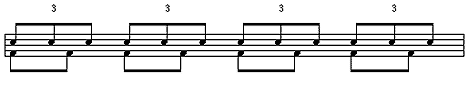
This is a polyrhythm:
jace

One major point to think about is that to qualify as a polyrhythm, the two constituting rhythms should be clearly heard and felt as separate rhythms, each with their own properties. If I were to play example 2 on two snare drums with the same pitch and the same loudness, it would sound like one rhythm, being the sum of the two parts! But it is no longer a polyrhythm (unless you put the two players far apart).

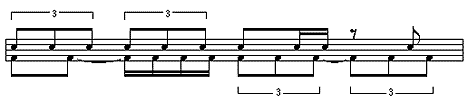
Another:
jace

Now some complicated examples: This example is clearly a polyrhythm: the top line has a rhythm based on a group of 4 notes, the bottom line has a rhythm based on a group of 3 notes. 3 and 4 are relatively prime to each other, hence it’s a polyrhythm.

jace

Now let’s change this rhythm a little bit so that it becomes:

jace

Is this still a polyrhythm or not?

If we look more closely to the subdivision for this example, we see that the rhythm on the first quarter is based on a group of twelve notes:

jace

The bottom rhythm didn’t change, so we have a group of 12 and a group of 3, which are not relatively prime and hence this is no longer a polyrhythm. As a matter of fact, the rhythm on the first quarter (of example 7) sounds like a 3/8 bar, regularly divided in three groups of 4!

Remember:

To be a polyrhythm, two rhythms (at least) are needed to form this polyrhythm, and these two rhythms: 1. should be based on relatively prime subdivisions 2. should be clearly distinct from one another *Both conditions must be met at the same time.

Here is another interesting polyrhythmic example:

jace

To see how close the two rhythms really are, lets set up the minimum subdivision of the beat that includes all notes:

jace

The accented notes denote the rhythm from example 9. The sixteenth note and the 2nd note of the quarter note triplet, differ only by 1/48 note! What’s that? A 1/48 note? Yes that’s another way of giving a name to a 32nd triplet! For the same reason I often call 8th note triplets 12th notes! (And quarter note triplets 1/6 notes). This gives rise to some very interesting time signature changes! Play four bars of 4/4 time alternated with two bars of 4/6 time. Or try this: two bars each of 4/4 – 4/5 – 4/6 – 4/7 -4/8.

If you experiment with this a little, you’re sure to come up with some interesting material. Give it a try!

A favorite:

jace

For more excellent information on the polyrhythms, check out “Musician’s Guide to Polyrhythms” by Peter Magadini. Originally in two volumes, this masterpiece was acclaimed the world over and named one of The Great Drum Books” by Modern Drummer magazine. Written for instrumentalists and vocalists alike, “MGTP” combines the material from both volumes and includes solos and exercises that feature polyrhythmic concepts with a supplemental audio tape. Topics covered include:

Rhythmic Ratios
6 over 4
7 over 4
3 over 4
11 over 4
13 over 4
Combining Various Polyrhythms
Polyrhythmic Time Signatures

Classic book, good reading. Check it out. Also check out my old Pre-Web MIDI Polyrhythms Project from 1993. I dusted it off and posted it here.
Long before the Web, I studied Music and MIDI in college while working for an electronic drum company. A good combination for a 21-year-old old drummer who likes toys.

When I look back on those college years, one of the most fascinating subjects I remember studying was polyrhythms. As I delved deeper into the subject, I came across a music book entitled “POLYRHYTHMS: The Musicians Guide” by Peter Magadini. This book is a method designed to teach the creative musician and music student the art of playing polyrhythms.

Literally, the word “polyrhythm” means “many rhythms”. In common use the term means two or more rhythms played simultaneously, or against each other. Polyrhythms can also be thought of as two different meters (time signatures) played against (or more accurately, with) each other. Note that the word “against” is often used by musicians to describe very basic polyrhythmic functions (i.e. 3 against 2). However, to be more precise and accurate, the word “against” is better defined when thought of as meaning a rhythm that goes “over”, “under” or “with” another rhythm which is played at the same time.

In my effort to grasp Magadini’s method back in 1993, I used my trusty Mac Classic (maxed out with a whopping 4 megs of RAM) along with a rhythmic sequencer to program all the different patterns, exercises, and solos presented in the book. Once I translated all this charted music into MIDI files, I found them to be an invaluable supplement to the reading material. Rhythmic dictation on paper is one thing; hearing and feeling the distinct mathematical relationships between the notes in real time is the only true way to internalize the different polyrhythmic patterns and truly comprehend the groove. There really is no other way, unless you are some sort of Rhythm God.

I recently was digging through a box of college stuff and came across some dusty floppy disks of these MIDI files I created so long ago. It was quite entertaining to fire these up again…I really had a lot of time on my hands back then.

There are two major polyrhythm MIDI projects. The first project was for my own personal use…a complete collection of virtually every rhythmic pattern presented over an ostinato of 4/4. Using Magadini’s choice of orchestration, I created an ostinato of kick and hat: four on the floor with the kick drum, hat closed on 2 and 4, i.e., boom-chick-boom-chick, etc. The different polyrhythms were then performed on a snare drum on top of the ostinato. Once I created these MIDI files, I could then play each pattern over and over in order to internalize the rhythm. The second project was created as a supplement to the book itself. The book contains several exercises and solos, but unfortunately the book has no speakers! So by programming these patterns as MIDI files, I was able to realize the patterns in real time on the computer.

Ok the first project. Here are the individual patterns for nearly every possible mathematical breakdown of 3, 4, 5, 7, 9, 11, and 13 over a bar of 4, played on snare drum over the 4/4 ostinato at a tempo of 120bpm. I looped each for 16 bars:

Ostinato
1 over 4 (whole note)
2 over 4 (half note)
3 over 4 (half note triplet)
Quarter Notes
5 over 4
6 over 4 (quarter note triplets)
7 over 4
Eighth Notes
9 over 4 (triplets of 3)
10 over 4 (eighths of 5)
11 over 4
12 over 4 (phrased as 12/8)
12 over 4 (phrased as eighth notes of 6)
13 over 4
14 over 4 (eighths of 7)
15 over 4 (triplets of 5)
Sixteenth Notes
18 over 4 (triplets of 6)
20 over 4 (sixteenths of 5)
21 over 4 (triplets of 7)
22 over 4 (eighths of 11)
24 over 4 (thirty-secondths of 3, or sixteenths of 6)
28 over 4 (sixteenths of 7)
33 over 4 (triplets of 11)
44 over 4 (sixteenths of 11)

Now, for those of you who have the book, here’s the stuff in MIDI format. Enjoy:

SECTION I: 3 AGAINST 2

P.6 Exercises
P.7 Exercises
P.8 Combination I
P.8 Combination II
P.8 Combination III
P.8 Combination VI
P.9 Mixed Combos

SECTION II: 3 AGAINST 4

P.11 Exercise I
P.11 Exercise II
P.12 Exercise I
P.12 Exercise II
P.13 Exercise I
P.13 Exercise II
P.14 Exercise I
P.15 Exercise II
P.16 Combinations
P.16 Mixed Combos
P.17
P.18 Solo
P.18 VMixd Comb.
P.19 Solo

SECTION III: 5 AGAINST 4

P.20 Exercise I
P.20 Exercise II
P.21 Exercise I
P.21 Exercise II
P.22 Exercise I
P.22 Exercise II
P.23 Exercise I
P.23 Exercise II
P.24 Short Combos
P.24 Mixed I
P.24-25 Mixed II
P.25 Solo I

SECTION VI: Solos (Comb. Sects 1, 2, 3)

P.27 Solo I
P.27 Solo II
P.27 Solo III
P.28 Solo IV
P.28 Solo V
P.29 Solo VI
P.29 Solo VII
P.29 Solo VIII Memo

For more information on this stuff, see the Polyrhythms entry.

jace

Ah, the ultracute Sally-Field-Gidget throwback brunette twins on Jet Skis. Let’s not forget the David Bradford twins with the synchronized under the leg Frisbee flips either. Very ’80s.

Cool dogs too!

To see this classic commercial, download the following .wmv file (1mb) to your computer and open it:

>> Doublemint Gum Commercial

jace

This is my version of my ABCs on October 15, 1972, as recorded by my Grampa. Gotta love the accelerando.

>> Listen here!

jace

A farmer has ten trees. Starting with an empty field, he instructs his farmhand to plant these ten trees in five rows of four. It is possible. How?

84% of a raw apple is water.

99% of the pumpkins sold in the US end up as jack-o-lanterns.

A pineapple is a berry. [click to continue…]

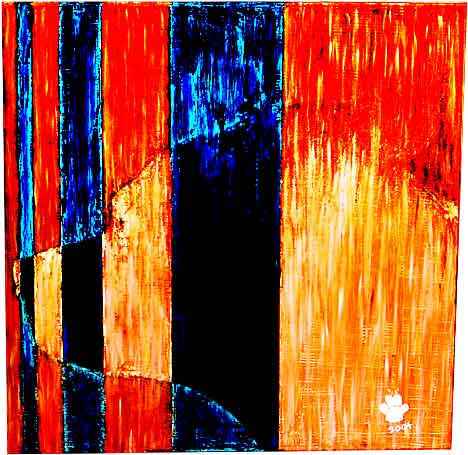
Kona

“Kona”
48″ x 48″
Oil and acrylic on mounted lithograph
2004

>> Shake it off