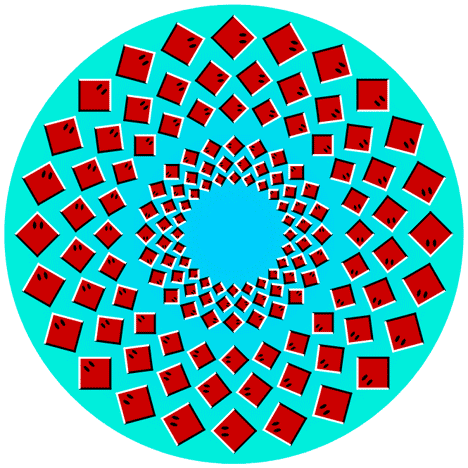
The outer ring of rays appears to rotate clockwise while the inner one counterclockwise.
*Compare to Rotating Snake Illusion
Source: A. Kitaoka
The outer ring of rays appears to rotate clockwise while the inner one counterclockwise.
*Compare to Rotating Snake Illusion
Source: A. Kitaoka
“Labor Day differs in every essential from the other holidays of the year in any country,” said Samuel Gompers, founder and longtime president of the American Federation of Labor. “All other holidays are in a more or less degree connected with conflicts and battles of man’s prowess over man, of strife and discord for greed and power, of glories achieved by one nation over another. Labor Day…is devoted to no man, living or dead, to no sect, race, or nation.” [click to continue…]
About three months ago a 20-pound female terrier mix, horribly neglected and left for dead, was brought in to the vet. She was pregnant. The father is unkown.
She died right after giving birth to 12 pups. 11 of them died. Only one survived.
Meet our sole survivor. Vivor, as we call him. Vive:
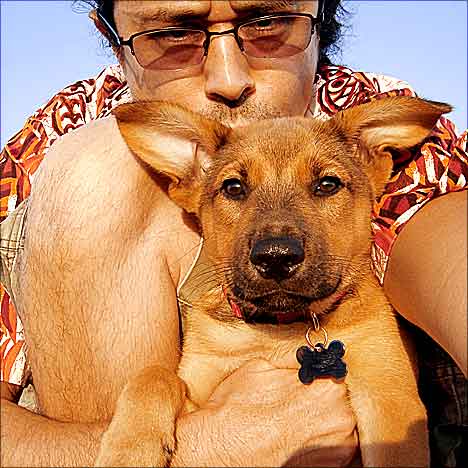
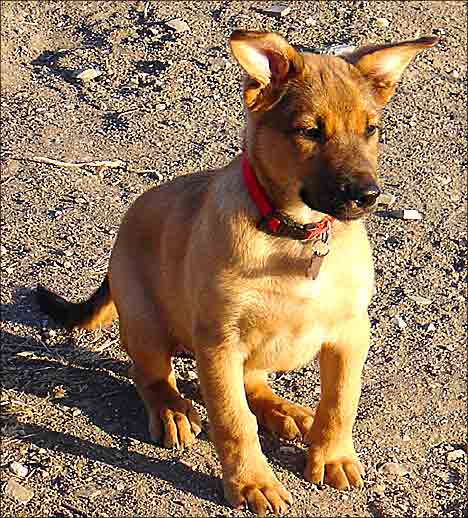
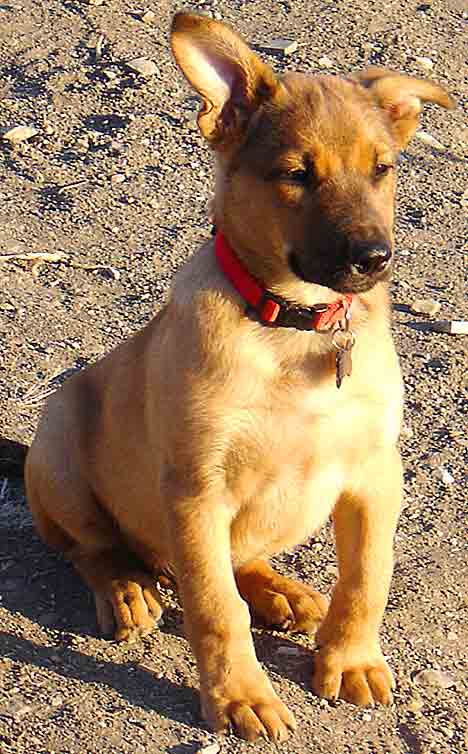
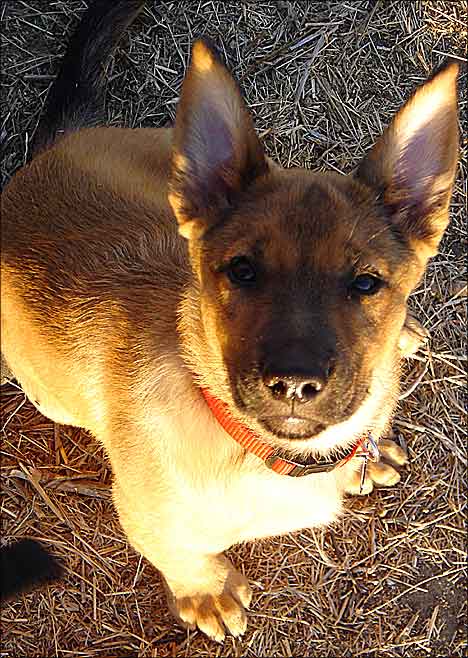
We know the mother’s a terrier mutt; we’re guessing the father must’ve had anything from Shepherd to Boxer to Kangaroo to Chow to Mountain Lion to Basset, and likely lots more. Little Vivor has everything under the sun. A real cosmo, this guy. With big feet.
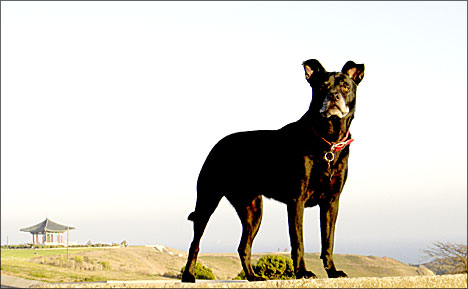
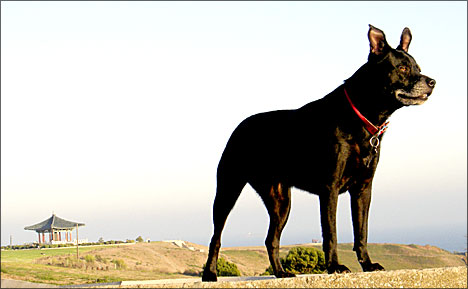
Meet the most beautiful dog on the planet. Kona joined me as a pup back in 1999 and has enriched my life beyond description. Isn’t she gorgeous?
She’s a pit-lab, weighing in at about 50 lbs. and change. She loves to swim in the ocean, she loves pesto chicken, and she’s horrified by the sounds of fireworks. She also has too many nicknames to list here.
Here are a few shots that capture what I see every day. This is one of our favorite spots, Angel’s Gate, near the Korean Bell, in our own backyard. We’d be here every day if there weren’t other equally cool spots nearby to spend quality time.
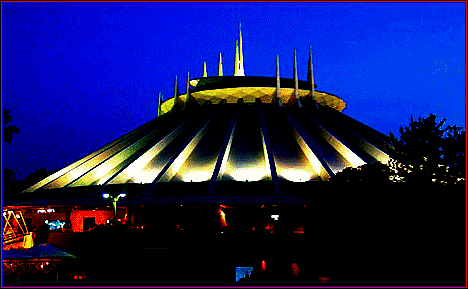
Thirty years ago, in the summer of ’75, my Pirate T-ball team and I — wearing our hats and jerseys — piled into a couple of pickup trucks with our coaches and made our way over to Disneyland during the opening month of Space Mountain. I have yet to experience such potent anticipation in life. There was nothing like it. Disneyland was the best thing ever, and Space Mountain — while I hadn’t experienced it yet — was already the best thing there. It was a day to experience the best of the best.
The line that day was record breaking, crawling back west all the way through Tomorrowland, past Monsanto’s Adventure Thru Inner Space, and out to Main Street. A two hour wait minimum. The whole experience marked the peak of my young imagination. We’d all heard about what Space Mountain was, a roller coaster through space, yet it was nearly impossible to comprehend such a thing at the age of six. I can remember one person coming out of the ride while we were standing in line, exhilarated, claiming “everything’s invisible!” Looking back now, I’m amused to realize that, at the time, it never occured to me that “darkness” equated to “invisible”. I can remember thinking that once we got inside, we’d all disappear. Like little invisible men, hats floating in mid-air.
On April 10, 2003, Disneyland abruptly shut down Space Mountain in order to redesign it and relaunch it in conjunction with the Disneyland 50th Anniversary in 2005. Additions such as new special effects, digital technology, an integrated audio system, and a completely revamped queue were to provide a new level of excitement to our classic ride.
Hmmm…was this going to be a good thing? Why change something so close to our hearts? They’d already robbed us of Adventure Thru Inner Space and Mission To Mars. Was the Space Mountain “improvement” going to follow that trend of loss?
We went last night to find out. The FASTPASSes were sold out, so we got in line in what was calculated to be a 70 minute wait.
Getting in line for Space Mountain in 2005 — at least last night — is the first difference you’ll notice. Rather than immediately boarding the escalating conveyor belt that takes you up to the upper courtyard, we instead enter the pavilion area to the left of that at ground level. Towards the back of that pavilion area is a ramp that goes counter clockwise, circling us back up to that upper courtyard. Once in the courtyard area, the experience of standing in line is much like what we remember, zig-zagging our way through the courtyard just outside the top floor of the Starcade.
Where the upper courtyard portion of the line ends, we used to continue our way into the blue hallways which took us downward into the building of Space Mountain. From these hallways we’d hear the soundtrack of space sound effects and flight control operators. However, in 2005, the line stops here, outside, in the courtyard. There are attendants that then count people out in finite groups, and we’re then allowed into the hallways one group at a time. This means that the hallway portion of the line is now cleared out, with no congestion. This is probably a safety decision. Walking through these descending hallways now, even on the busiest day, is reminiscent of those nights when you’d get in line at the last minute with nobody in the park.
Things different about the hallways include new plastic paneling, with only a couple sectors still retaining the familiar metal corrugated paneling on the walls and ceilings. Another big difference is that these hallways are completely closed off to the roller coaster itself. In the old days, we could look into the main building to see the glowing cars flying through the star-lit room over sillhouetted tracks, with the occasional chocolate chip cookie flying across the room, projected on the ceiling with the rest of the stars. This is gone. We do not get a glimpse of the inside of the ride until we’re actually in the car.
After the hallways, we get into the main multi-level room with the space probe hanging from the ceiling over the boarding area. This is all very familiar, except the paneling of the room and the probe itself is updated, displaying sleeker, more contemporary lines and looking less “boxy” than the ’75 version.
We got to the front of the line, and requested the front seat. Here we go…
Like before, we begin by heading directly towards the control operator behind the glass window and make a hard right to go upwards. This part is different, with new lighting effects, no longer having the red multi-beam light shining down in your face. One of the first things you’ll notice — almost subconsciously — is that the experience immediately feels richer. After a couple moments it’ll dawn on you that this is due to the personal speakers that are mounted right behind your head on your seat, playing sound effects.
We level off, make another right, and go through a tunnel with fantastic lighting effects that differ from the old version (they’re actually better). As we approach the end of the tunnel, we can see the stars approaching, and hear a control operator counting us down from our speakers: “Five … Four … Three … Two … ”
Blast off. It’s party time.
OK, the roller coaster’s track is basically the same as it was before, including that mandatory final drop that gives us that delicious moment of zero-gravity that all Space Mountain fans crave. What’s different is the visual and auditory experience. Gone is the big spherical glowing orange core thing. Completely redone are the projected stars on the walls and tracks, which surprisingly seem less convoluted and more focused than before. The lighting effects now seem to be stars exclusively, with no chocolate chip cookie or other secondary objects. Everything felt darker. I loved it.
I must say that the integrated audio effects profoundly enrich the experience. What I didn’t like was the choice of soundtrack during the main portion of the ride. It’s an upbeat rock and roll groove, sounding like something you’d hear while watching a chase scene on The A-Team. In my opinion, Space Mountain has always been rooted in unpredictability, being very elastic and unstructured, keeping you guessing. Mixing this up with a structured backbeat blaring in your ears didn’t work for me. They need to jazz that up a bit, or do away with the music altogether and use something more atmospheric.
Now for the end of the ride where we reach the bottom of the track and enter the orange lit tunnel as the cars stop and we all catch our breath. This is completely redone. Gone is the orange, replaced by a state of the art lighting effect that almost defies explanation. You need to see it for yourself.
It had been several years since I’d been on Space Mountain, and I’m happy to say that it was as big a rush last night as it was 30 years ago. It seems the more things change, the more they stay the same.
No disappointments here. It’s back!
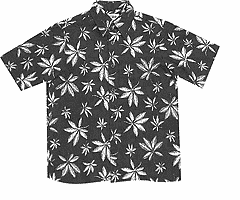 The aloha shirt is something that just about everybody knows. It’s become a cliche by now, having been around for about seventy years, and represents the most outwardly obvious souvenir of Hawaii that anyone has ever taken home. The aloha shirt, as one writer described it in 1953, is “like a postcard you can wear”.
Where did all these wonderful designs come from? The made jumble of things like Diamond Head and Aloha Tower, the garish, the sometimes bizarre flowers, the strange fish entwined in undersea plants, the surfers and canoe paddlers and hula dancers, the palm trees, the ukuleles, the helpful Hawaiian words sprinkled throughout — in short, all stereotypical Hawaiian images — where did they all come from? Answer: from designers too numerous to name, even if they all were known, who were inspired by the beauties of Hawaii. The original ones actually worked in the islands, but later there were many others employed by manufacturers in Japan and the U.S.A. who jumped on the bandwagon around 1950 when alohawear became an international craze.
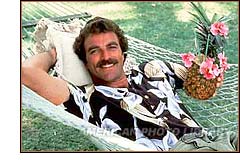 It had all started some years before that, though. In the early 1930s, the more adventuresome members of a younger island-born generation began to appear in shirts they’d had made from brightly colored Japanese silks and cottons. Such fabric was traditionally used in Japan only for young children since its riotous hues were considered inappropriate for adults, but restrictions like these were ignored in Hawaii. By 1935, such shirts werre a fad for young people of all races. Before long, serious designers began to produce fabrics with Hawaiian themes, and the “aloha shirt” had arrived.
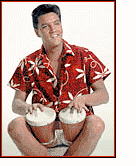 By 1939 the garment industry was flourishing, with much of its output intended for tourists. Local residents gradually took to this festive clothing too, helped by the invention of Aloha Week in 1947. During this yearly celebration of Hawaiian activities, every company urged its employees to sport the most brilliant alohawear they could find. The response was so enthusiastic that over the next decades such informality at work became the rule in Hawaii.
By the 1960s, the lavishly illustrated type of print with every possible Hawaiian motif thrown together had come to seem tacky and outdated, and manufacturers shunned it. But around 1970 such fabrics slowly began to creep back into style with the help (again) of the more adventuresome members of the younger and hipper set. This time the old shirts were dubbed “silkies” (even though they were made of rayon), and they eventually became prized possessions. You only rarely see old silkies around anymore since most have passed through their second stage of usefullness by now, but if you do , you’ll find it hard to believe that such an amazing garment would’ve been available for an unbelievable 75 cents new in 1936.
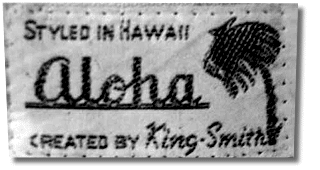 The alohawear era really began in 1936, when some local manufacturers got the bright idea of making ready-to-wear shirts for tourists who couldn’t wait several days to have one tailormade. One such businessman, Ellery Chun, registered the term “aloha shirt” that year as a variation on the numerous other “aloha”-named items meant for tourists. Shown here is a later version of the historic clothing label that, in effect, named an entire industry. The name of Chun’s store, King-Smith, is featured as the “creator” of the title.
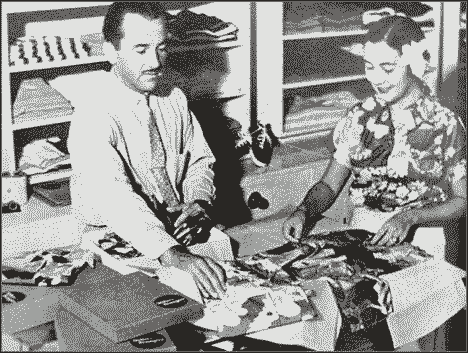
Another pioneer in the field was George Brangier, seen below with a female assistant handling the new clothing craze. Brangier and his partner Nat Norfleet started their company, Branfleet (later Kahala Sportswear), in 1936. All the shirts were made from traditional Japanese cloth, the predecessor to the Hawaiian designed fabric that would appear around 1937.
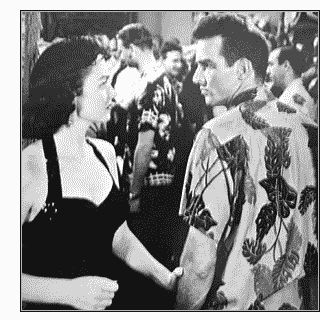 Alohawear’s popularity outside of Hawaii peaked in the 1950s when even mainland manufacturers were designing “Hawaiian” print sportshirts. Frequent publicity regarding Hawaii’s attempts to gain statehood all through the decade probably helped to make people aware of the islands and their fashions, but movies undoubtedly played a bigger role. “From Here To Eternity” dressed its principal male actors like Frank Sinatra and Ernest Borgnine in a succession of aloha shirts that more accurately reflected the fashions of the year the film was made (1954) than the year in which it was set (1941). Here’s a photo of a tense scene which takes place between “hostess” (in the book: prostitute) Donna Reed and angry soldier Montgomery Clift, clad of course in the necessary tropical print shirt.
“To arrive in Hawaii … and then to switch abruptly into one of those kaleidoscopic shirts in violent reds and wild blues and insane yellows … that is no procedure for a sensitive man to follow.”
–Waikiki Beachnik, 1960
*Loosely adapted from a book on Hawaiian nostalgia.
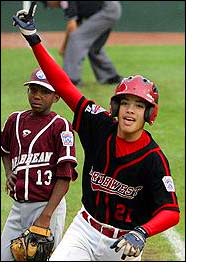
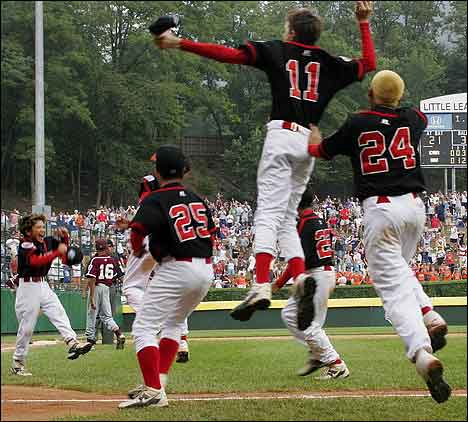
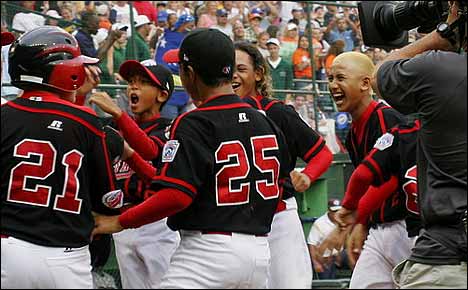
High fives to our boys from Ewa Beach on West Oahu, Hawaii, who — representing the U.S.A. — won the World Championship in a remarkable come-from-behind fashion. Down 6-3 in the 6th and final inning of the Championship game against the reigning champs for Curacao in the Caribbean’s Dominican Republic, the Hawaiian team tied the game 6-6, sending the game into extra innings. Catcher and fifth batter Michael Memea — who had been underachieving offensively all week — hammered one over the centerfield wall to give Hawaii a 7-6 win, the first game-ending home run in a Little League championship game.
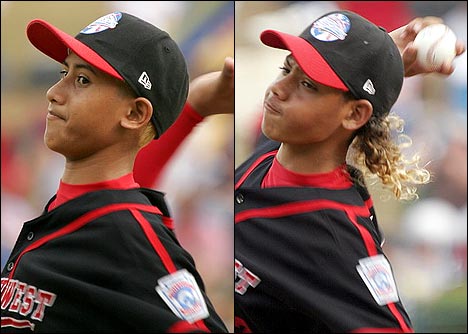
West Oahu went undefeated in Williamsport this year, with a total record of 6-0. I watched the first three games with my uncle this week while I was back there; the games aired at 9:00am Hawaiian time. The West Oahu team completely pounded their opposition, winning by large margins, having multiple back-to-back homeruns, multiple double plays, and great pitching. Their batting lineup was its own Murderer’s Row; there are no less than four boys that were hitting the ball out of the park, and the team had a tournament-leading 10 home runs. They’ve got four guys that can throw gas for strikes; Vonn Fe’ao was throwing the ball almost off the charts at 78mph, which is calculated to be the equivalent of 100mph from the MLB distance. *Little League mounds are 45 feet from home plate, whereas the MLB mounds are 60 feet away.
Congratulations to the West Oahu players on a job well done and an unforgettable childhood experience that most of us have only dreamt about. You made Hawaii and the U.S.A. very proud today.
Shaka, braddas!