

While out visiting family for the Thanksgiving break in Temecula, my pilot friend Tom offered to take me up flying in his experimental aircraft. It’s a Lancair 360; a kit plane that he built from parts.
I’d always wanted the opportunity to fly over the South Bay area of Los Angeles, where I live. Looking down on anonymous landscapes from an airplane is nowhere near as interesting as looking down on the familiar. I asked Tom if we could fly out over the coast and head up to San Pedro so we could fly over my backyard. We’ve got stunt planes flying over us on a daily basis, and I’ve always wanted to get up there and check things out.
I met Tom at his French Valley hangar, located in Murrieta. I couldn’t believe how small the plane was. At first glance, it looked like a one-seater. It does in fact seat two people snugly, side by side. I had to almost cross my knees just to fit my legs in, scooting my feet down to the nose of the plane. It was like boarding Space Mountain or something.
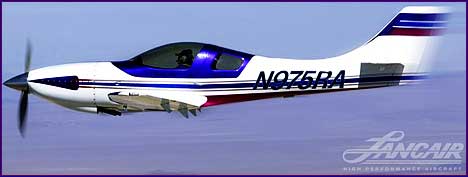
Once squeezing in to the cockpit, Tom gave me a quick tour of the instruments and our flight plan, furnishing me with a ball cap and a headphones/mic rig. We’d be communicating with each other this way, while also communicating with air control.
We did a quick review of the weather conditions on the radio and made our way out to the runway. As planned, we flew west over the mountains towards the ocean, which put us at about Dana Point. We then hung a right and cruises along the beach up to the Palos Verdes Peninsula.
Once in the air, it’s amazing how your perspective of time and space changes. Within 15 short minutes we had cleared the mountains and were in John Wayne Airport’s airspace, where the sights became familiar. Ha! There’s the cliffside mansions Laguna Niguel. Corona Del Mar. Huntington Beach pier. Irvine’s cluster of buildings. We’re flying! Seal Beach. Neptunes! The wetlands! Already to Long Beach? No way. Yes way, because there’s the aquarium and Convention Center. The Pike. I can almost make out P.F. Chang’s! We’re already coming up on Terminal Island. There’s both bridges. I can see the silhouette of Palos Verdes coming out of the haze now. Ah, yes, there’s the Korean Bell! One of our favorite playgrounds. Cabrillo Beach Pier. Paseo Del Mar. Pac Diner! Surreal. It’s only been 25 minutes since we were on the ground, and now I’m looking down at my own neighborhood, which is an hour and a half drive by car with no traffic.
We came down low, a few hundred feet above the water. Once we reached the Nike Missile Base, which is literally yards from my house, we circled around and headed back to French Valley.
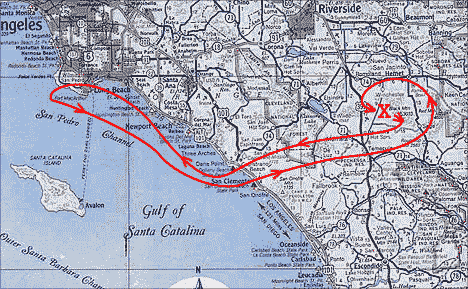
Before landing, we flew over Pechanga Casino and my dad’s house, circling around a couple times, low enough to see details like the lounge chairs by the pool and the cars in the driveway. We then flattened out and headed back towards the nearby airport, when Tom told me to take over the driving. I turned the thing a couple times, dipped, climbed, and began breaking a sweat. The reality of what was going on started to give me clammy palms, and things started feeling stuffy. I suddenly longed to pop the window and get some fresh air.
Tom took over, and schooled me a bit on some g-force action. Since our Lancair 360’s a hot-rod, we’re going much faster than all the other incoming air traffic, making it impossible for us to “get in line” for landing, so to speak. We had to do our own thing, circling the airport a couple times until our turn, at which point Tom brought us down for a flawless landing.
We couldn’t have landed at a better time. I was just on the verge of beginning to feel uncomfortable, similar to being on a rocking boat for five minutes too long. Fortunately I hadn’t eaten anything all day, so there was nothing to lose.
We wheeled the plane back into the hangar, where Tom broke out some of the blueprints he had in his shop for the kit plane. It’s like a model airplane hobby on steroids. Really cool stuff. He also showed me a couple other of planes in the adjacent hangars, which belonged to his colleagues. One of these was a bi-plane that they had just put together made of wood and kite material, like the Red Baron. Nice. It’s always inspiring to see somebody living out their passion.
Throughout the remainder of the afternoon, I experineced a bit of psychological disorientation. Really, it’s surreal to be in Murrieta one moment, and then an hour later you’re standing there having just watched cars driving out of the parking lot of Pacific Diner in San Pedro nearly 100 miles away. It almost doesn’t register. It almost feels fake, like you were dreaming. Like time travel or something. Hard to believe.
A great way to spend the Friday after Thanksgiving. Thanks Tom!
On Thanksgiving afternoon, I dropped in to Pechanga Casino’s poker room, which is only five minutes from my folks’ house in Temecula. Sat down at a 2/4 table.
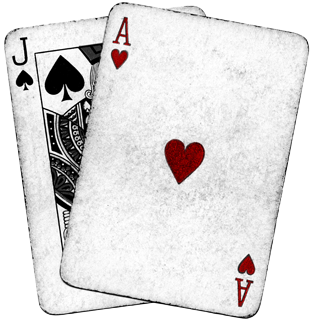
Within a few minutes, I found myself in late position looking down at a 5 of clubs and 4 of clubs. Those little suited connectors. Fun stuff. I like raising with these hands before the flop. Doing this helps narrow the field a bit, forcing the low cards and mediocre hands out of the pot, leaving the big hands like AK or QQ. This way, if your small cards happen catch something on the flop, chances are you’ll be alone.
The flop comes 3 of clubs, Queen of diamonds, 6 of clubs. Well, whaddya know. I’ve got all kinds of things going on here; I’ve got the open-ended straight draw, a low flush draw, and a miracle straight flush draw.
I’m now in a situation to be calling things. There’s an early bet, suggesting somebody’s got a Queen, a pocket pair, or even some high clubs. A couple people call. I call.
The turn’s a red nine. Misses me. Again, there’s an early bet with some calls. I need to call.
The river hits me square: the 2 of clubs. I just made my straight flush. I naturally raise the pot, and a couple people call.
Turn ’em up, wow. Straight flush. The dealer calls the floorman over to announce that we’ve got a jackpot @ Table 11. I was delighted to learn that Pechanga has jackpots on the hour on Tuesdays and Thursdays. My straight flush was the high hand of the day, earning me $200.
I’m so thankful for that deuce of clubs on the river.
The Native American name for turkey is ‘firkee’. Some say this is how turkeys got their name.
Turkeys originated in North and Central America, and evidence indicates that they have been around for over 10 million years.
Until 1863, Thanksgiving Day had not been celebrated annually since the first feast in 1621. This changed in 1863 when Sarah Josepha Hale encouraged Abraham Lincoln to set aside the last Thursday in November “as a day for national thanksgiving and prayer.”
In Mexico, the turkey was considered a sacrificial bird.
Domesticated turkeys (farm raised) cannot fly. Wild turkeys can fly for short distances at up to 55 miles per hour. Wild turkeys are also fast on the ground, running at speeds of up to 25 miles per hour.
Only male turkeys (toms) gobble. Females (hens) make a clicking noise. The gobble is a seasonal call during the spring and fall. Hens are attracted for mating when a tom gobbles. Wild toms love to gobble when they hear loud sounds or settle in for the night.
The heaviest turkey ever raised weighed in at 86 pounds — about the size of a large German Shepherd — and was grown in England, according to Dr. Sarah Birkhold, poultry specialist with the Texas Agricultural Extension Service.
Mature turkeys have 3,500 or so feathers. The Apache Indians considered the turkey timid and wouldn’t eat it or use its feathers on their arrows.
More than 45 million turkeys are cooked and 525 million pounds of turkey are eaten during Thanksgiving.
Ninety percent of American homes eat turkey on Thanksgiving Day. Fifty percent eat turkey on Christmas.
North Carolina produces 61 million turkeys annually, more than any other state. Minnesota and Arkansas are number two and three.
The fleshy growth from the base of the beak, which is very long on male turkeys and hangs down over the beak, is called the snood.
At one time, the turkey and the bald eagle were each considered as the national symbol of America. Benjamin Franklin was one of those who argued passionately on behalf of the turkey. Franklin felt the turkey, although “vain and silly”, was a better choice than the bald eagle, whom he felt was “a coward”. He stated that it was more respectable than the bald eagle, and a native of North America.
According to the U.S. Department of Agriculture, more than 45 million turkeys are cooked and eaten in the U.S. at Thanksgiving. That’s one sixth of all turkeys sold in the U.S. each year.
In 1995, retail sales of turkey reached approximately $4.4 billion.
Age is a determining factor in taste. Old, large males are preferable to young toms (males) as tom meat is stringy. The opposite is true for females: old hens are tougher birds.
A turkey under sixteen weeks of age is called a fryer, while a young roaster is five to seven months old.
Turkeys are the only breed of poultry native to the Western Hemisphere.
Turkeys have great hearing, but no external ears.
Turkeys can see in color, and have excellent visual acuity and a wide field of vision (about 270 degrees), which makes sneaking up on them difficult.
Turkeys have a poor sense of smell , but an excellent sense of taste.
Turkeys sometimes spend the night in trees.
Turkeys can drown if they look up when it is raining. They can also have heart attacks: turkeys in fields near the Air Force test areas over which the sound barrier was broken were known to drop dead from the shock of passing jets.
The ballroom dance known as the Turkey Trot was named for the short, jerky steps a turkey makes.
As far back as 1000 A.D., Native American Indians raised turkeys for food. Aztec Indians in Mexico were raising them as early as 200B.C.
Turkeys originally existed in the eastern US. and Mexico.
The Average American consumes over 15 pounds of Turkey per year.
Americans consume over 675 million pounds of turkey on Thanksgiving Day.
Turkey, like poultry, is lower in cholesterol than beef an many other meats. The dark meat (thigh, legs,) contains more fat and cholesterol than white meat.
Male Turkeys are called “Toms”, female turkeys are called “Hens” and baby turkeys are called “poults”.
Turkey eggs are tan in color and speckled with brown. They are about twice as large as chicken eggs.
In 1947, the first Presidential pardon was ceremoniously given to a turkey.
That long, loose skin that hangs down from a turkey’s neck is called a “wattle”.
Turkey contains an amino acid called “Tryptophan”. Tryptophan sets off a chemical chain reaction that calms you down and makes you sleepy.
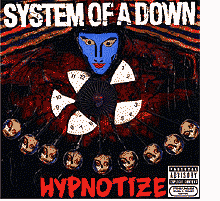 The second half of System of a Down’s 2005 double-album, “Hypnotize”, was released on November 22nd, completing the “Hypnotize/Mezmerize” package. Interestingly, one can say that the two records were released in reverse order; “Hypnotize” almost feels more like a prequel to May’s “Mezmerize” than a sequel.
System’s often been conveniently pigeon-holed into the category of “new metal”, apparently due to their heavy abrasiveness that most people associate with the idea of metal music. However, this is only one of the facets of this incredibly dynamic band, which I would describe as sort of a cross between Pink Floyd, Slayer, Zappa, Faith No More, and the Beatles, with subtle hip-hop influences and melodic/harmonic sensibilities that seems to come from a mythical place where carpets fly. Like any great original band, there are certain familiarities and influences sensed in the music without sounding like things are being blatantly copied. It’s all System. [click to continue…]