Note to Self,
Context is an amazing thing. (Case in point: “Shining“.)
We’ve become quite fascinated with a certain little thing in language that doesn’t really have a name yet. Let’s call the phenomenon “Dialogue Illusions” for now.
Example:
In many an Escher piece, we have two distinctly different ways of looking at it. Two perspectives, giving the piece two contexts. (i.e.: Is it black fish on a white background? Or, wait, it’s actually white birds on a black background. Wait…)
Our brain toggles between the two perspectives, perhaps even uncontrollably. When the illusion is tight, we find our eyes walking that very sharp line between the two contexts. It feels trippy, and it’s undebatably cool.
This same phenomenon also occurs in the spoken word. It is clearly a device we can pull from in order to apply it artistically in English. Let’s look into this more closely.
Also, let’s rename our Optical Illusions category to the broader Illusions, as there are many illusions in the Universe that have nothing to do with our eyes.
Done.
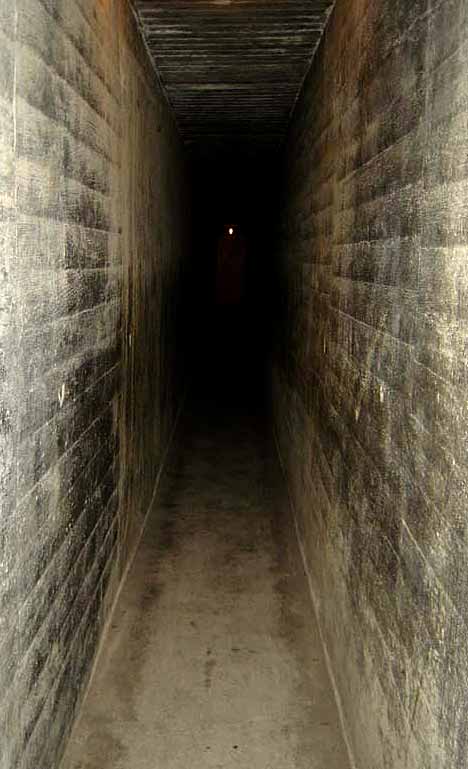
Taken beneath Battery Osgood-Farley at Fort MacArthur.
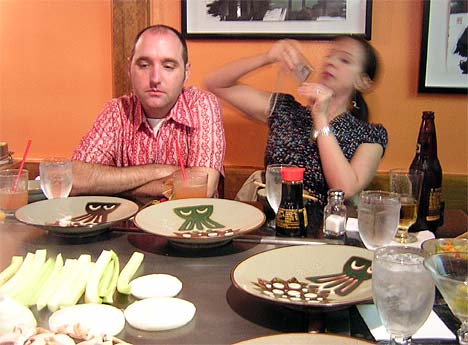
Bret and Sharon at Benihana Beverly Hills. Photo’s unaltered. I’m really beginning to like the non-flash mode on the camera while indoors.
Here’s a thought. Do this:
Think about how much you know.
And then think again.
We’ve had our beloved Kona, a female pit-lab, for over seven years. Got her as a puppy. She’s enriched our lives beyond explanation. As we gradually ease into her sunset years, she’s beginning to slow down a little bit, losing the energy she once had as a pup. The sinking feeling in my heart becomes heavier and heavier as the inevitable draws nearer each year.
Last year we adopted another pup, a little guy we call Vive. He just turned one year old this month. Being so accustomed to Kona, having the little man around has added an entirely new dynamic to the situation.
What’s really interesting is the profound differences between the male and the female, which have become more apparent in the last year since adding Vive to the mix. Here are five differences that come to mind:
1. Kona loves the ocean; Vive is afraid of water.
2. Kona’s always been really picky with her food; Vive eats anything.
3. Kona loves to cuddle for hours; Vive’s too restless for such a charade.
4. Kona’s afraid of fireworks; Vive doesn’t seem to notice.
5. Kona’s never pissed on the refrigerator.
The most familiar English terms for father include dad, daddy, papa, pop, and pa. Other colloquial expressions include my old man.
Whatever it is your kids call you, have a great day.
- Romani: “dad”
- German: “Vater”, “Papi”, “Vati”, “Papa”
- Hebrew: “av” or “aba(h)”
- Yiddish: “tatti” or “tay”
- Urdu: “Abbu” or “Abbu-ji” or “Abbu-jan”
- Bangla: “Baba” or “Abba”
- Kannada: “Appa”
- Hindi: “Papa” or “Pita-ji”(formal) or “Baap”(colloquial)
- Polish: “tata”
- Czech: “táta”
- Hungarian: “apa” or “apu”
- Filipino: “tatay”, “itay”, “tay” or “ama”
- Portuguese: “pai” or “papai”
- French: “papa”
- Dutch: “papa”
- Italian: “papá” or “babbo”
- Arabic: “babba” or “yebba” or “abbi” (classical)
- Russian: “papa”
- Chinese: “bà” or “bàba” (informal)
- Kiswahili: “Baba”
- Persian: “pedar”, “pitar” or simply “Baabaa”
- Japanese: “otōsan”, “papa”, “chichi”
- Spanish: “papá”
- Nadsat: “Pee”
- Turkish: “baba”
- Malay/Indonesian: “Abah”, “Ayah” or “Bapak”
- Swedish: “Pappa”
- Vietnamese: “Ba” (common) “Bo” (less common) “Cha” (archaic)
Anybody who can’t find a way to love this either took their VH way to seriously, or was never a fan the first place.
>> I ain’t the worst that you’ve seen…