“Today we celebrate our Independence Day!”
— Bill Pullman, ‘Independence Day’
A neighbor of mine planted a gang of fruit-bearing(!) banana trees in his backyard a couple years ago. They’ve gone off, growing at least twenty feet tall. Think Disneyland’s “The Jungle Cruise”.
With his trees sprouting new pups this Spring, he let me dig a few up. Instant transfer style, right out of his yard and into mine. I planted five pups a couple weeks ago. We’ll see how they do.
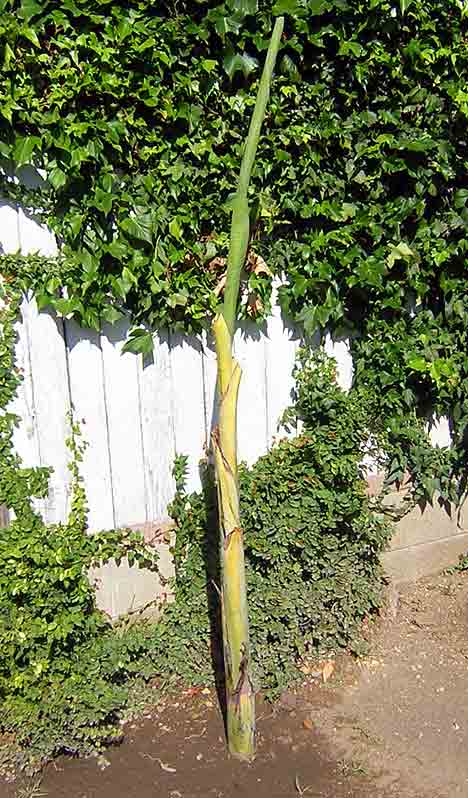
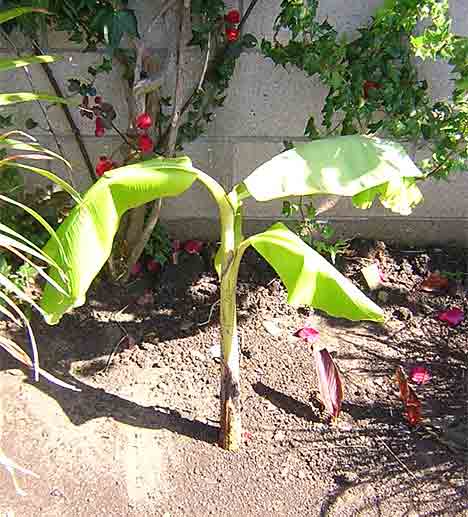
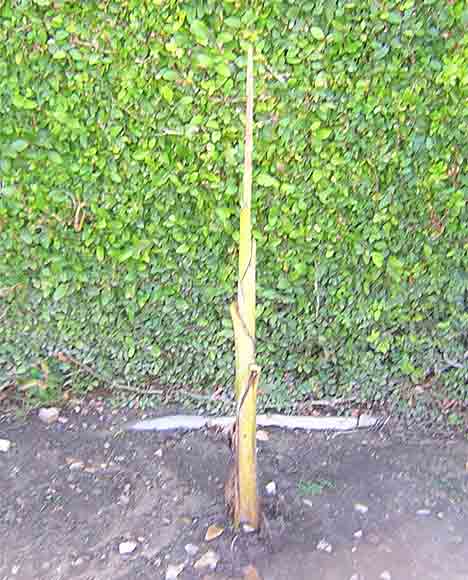
Photos of the five taken around mid-June 2006, right after a trim:


The origin of both the barbecue cooking activity and term are somewhat obscure. The word itself varies in spelling; variations include barbeque, BBQ, and Bar-B-Q. In Australia the word is often shortened to barbie.
A plausible origin for the word, originally provided in a 1970’s French television series by Alain Bombard (French navigator who crossed the Atlantic Ocean single-handed in a rubber inflatable raft, subsequently Socialist politician and Mayor in France), ascribes provenance to the French West-Indies: French Pirates (also called: “Boucaniers” or Buccaneers – from the French “Bouc”, or Male-Goat) would habitually impale their goats on spits and roast them on an open-fire. The goats were impaled “de la barbe au cul” (from beard to butt) and thus barbe-cul = barbecu = Barbecue (the “L” in cul is silent in French).
Smoky Hale, author of The Great American Barbecue and Grilling Manual, claims that the Tainoof the Caribbean used a term “Taíno barabicoa” which means “The sticks with four legs and many sticks of wood on top to place the cooking meat.” There is also the Taíno word “barabicu“, which translates as “sacred fire pit”. In one form, barabicoa or barbicoa indicates a wooden grill or a mesh of sticks; in another, barabicu, it is a sacred fire pit.
Traditional barbicoa implies digging a hole in the ground putting some meat (goat is the best, usually the whole animal) on it with a pot underneath (to catch the concentrated juices, it makes a hearty broth), cover all with maguey leaves then cover with coal and set on fire. A few hours later it is ready.
While not everyone agrees that barbecue originated with the Taíno, researchers do generally agree that barbecue originated in the Caribbean. There is ample evidence that the word and technique migrated out of the Caribbean and into and through other cultures and languages (with the word itself moving from Caribean dialects into Spanish, then French, then English in the Americas). This would mean that the word “slowly evolved from barbacoa to barbecue and barbeque and bar-b-que and bar-b-q and bbq.”
In the Southern United States, the word “barbecue” is used predominantly as a noun which specifically refers to roast pork (which is then chopped, pulled, or sliced, depending on region, and served with a tomato, vinegar or mustard-based sauce). Many in this region believe the term BBQ resulted from when roadhouses and beer joints with pool tables advertised “Bar, Beer, and Cues.” This phrase was shortened over time to BBCue, then BBQ. Other barbecue supporters believe the word “barbeque” is a result of a gradual misunderstanding of the “BBQ” abbreviation. Due to this abbreviation, with the third syllable “-cue” being represented by the identically-sounding letter “Q,” people came to believe that the word was spelled “barbeque.” This is also evident in viewing the word’s Taíno roots, with all three variations being spelled with the letter “c,” as opposed to “q.”
Source: wikipedia.org
I’ve never read King’s novel, but it’s now in queue.
The other day I rented 1997’s “The Shining” (miniseries), a three hour adaptation of King’s novel with a 320-page script written by none other than Mr. King himself.
Like so many people, I’ve seen Kubrick’s 1980 adaptation several times, and it’s a film that is so deeply rooted into our social consciousness that it’s difficult for us to imagine anybody other than Jack “Here’s Johnny!” Nicholson playing the part of Jack Torrance.
After doing a quick viewing of the miniseries, I then rolled it again along with the bonus commentaries which included Stephen King. I’ve become completely fascinated with the story, and now have a new appreciation for it that extends far beyond Kubrick’s re-imagined version.
Being familiar with Kubrick’s 1980 version, and then listening to King discuss not only the novel itself but the 1997 adaptation, is a very cool exercise in adaptation study.
To recap, the story outline:
Jack Torrance, a struggling writer and recovering alcoholic, takes a job as a winter caretaker in a Colorado hotel which will allow him to finish a piece of work. With his wife and son with him on the gig, he begins to see visions of deceased employees. With evil intentions, they manipulate Jack to the dark side, putting his family in jeopardy.
What’s interesting here is to study the distinct difference between Kubrick’s version and King’s original vision. The two takes are arguably polar opposites, and it comes down to perspective.
In Kubrick’s adaptation, he’s taken the conflict and EXTERNALIZED it into the form of a ghostly haunt. Not unlike “The Amityville Horror”, Jack Torrance becomes possessed by the spirit of an evil murderer from 1921. This murderer, vicariously through Jack, attempts to repeat his evil deeds by attacking Jack’s family with an axe (btw, there is no axe in the novel). Kubrick’s “The Shining” is a paranormal horror flick. That’s cool.
But even cooler in my opinion, is King’s original vision, which Kubrick deviated from. By comparison, one could argue that King’s original vision is less paranormal horror, and more psychological thriller. Less Amityville, more “Fight Club”.
According to King, he wrote “The Shining” during a time in his life where he was drinking a lot, and had a couple toddlers. He found himself startled at some of the thoughts he was having towards his own children, who were irritating the hell out of his drunk 27-year-old mind.
King explains that Jack Torrance’s struggle at the Overlook Hotel is less external (as Kubrick portrays it), and much more INTERNAL. He says it’s actually a metaphor for alcoholism. The spirits that he encounters in the hotel aren’t spirits in a metaphysical sense, but internal demons associated with addiction. Notice the role of alcohol — or lack of it — as Jack spirals.
So from the wife and son’s point of view, there are no ghosts. All they know is that Dad’s been drinking and he’s going crazy.
Another thing that I missed in Kubrick’s version suddenly dawned on me as I watched the King version. Quite simply, it’s King’s choice of character names for the father and son:
JACK and DANIEL.
Bottoms up.

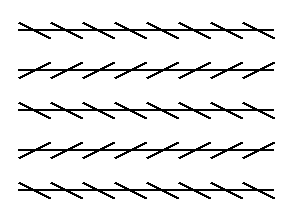
The horizontal lines are parallel but appear to tilt; the acute angles formed by the horizontal lines and the short inducing lines appear to expand.
It is said that the illusion is maximized when the intersecting angle is between 10 and 30 degrees. Some references claim that any angle from 0 to 90 degrees produces this illusion, yet this was not supported by other references.
The Zöllner Illusion is characterized by acute-angle contraction, intensified by the oblique arrangement. It’s formed by three elemental illusions. Two are acute-angle expansion illusions; the third is an acute-angle contraction illusion.
Source: A. Kitaoka