
“I’ll stick around, and learn from all that came from it.”
–Foo Fighters

Happy 40th anniversary to Dad and Mom!
Other things that happened that summer of ’67: the Beatles release Sgt. Pepper’s, the first color television broadcasts hit the airwaves, Jayne Mansfield dies in a car wreck, race riots and protests break out everywhere, and Pink Floyd releases their debut album. =more=

“Stewart Copeland’s Drum Kit in Four Colors Borrowed from the Sixteenth-Century Palette of Pieter Bruegel the Elder”
A Police concert, a camera, 10c 80m 80y 0k, 40c 10m 50y 0k, 50c 40m 60y 0k, 60c 60m 70y 40k, and Photoshop
2007

Back in 1994 I won a trip to Europe on a game show. The whirlwind tour took us through seven countries: England, Holland, Germany, Austria, Italy, Switzerland, and France.
The tour was put on by a company called Contiki Holidays. The drill: get on a bus (euphemism: “coach”) with about fifty other young people, a driver, and a chaperon, and hit the road for about two weeks. Among the fifty or so people were Americans, Brits, South Africans, and a group of about twenty people from Japan who didn’t speak much English.
If I were to pick one highlight from that trip to tell you about, the one that sticks in my mind like no other, it wouldn’t be the coffee house menus in Amsterdam, or the white water rafting in Austria, or the time wasted looking for a decent piece of pizza in Venice, or falling asleep to the distant sound of cowbells in an open-windowed chalet at the top of Mount Pilatus in Switzerland, or tripping out in the Haunted Mansion at Euro-Disney outside of Paris, or looking for ice in London. Better. It happened on the bus. [click to continue…]


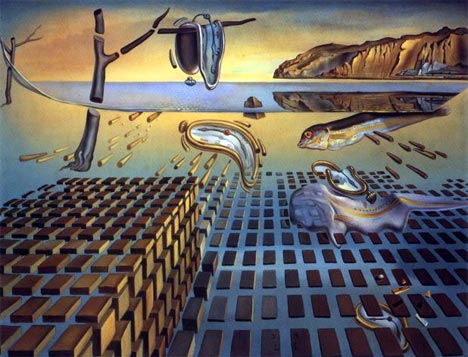
“The Disintegration of Persistence of Memory”, 1952-1954
Artist: Salvador Dali
Analysis:
This painting can be considered as a companion piece to another work that Dalí had done many years before, namely The Persistence of Memory in which Dalí initially created the scene on which this painting is based.
The ochre colored plain of the ground, has been divided up into cubic shaped blocks, and the addition of the rhinoceros horns in the upper left-hand portion of the painting also refers to Dalí’s fascination with the molecular world. The melting watches and landscape of Cadaqués make another appearance herein, and the addition of the fish serves as a witness to the event.
Dalí created this painting as a continuation of his themes of Nuclear Mysticism by applying a perspective of Divisionism to the original painting. Dalí painted this work to explore the effects of nuclear weaponry, asserting that the invention of such weaponry had a profound effect upon everyone on the planet, even those in the small fishing villages along the coastline of Spain.
Source: dali-gallery.com