I don’t need no
Education.
I don’t need no
Home Depot. Pulled
Up the floorboards
In the main room.
Gonna count to
Thirty-two.
Hey!
Teachers!
Feel that binary!
All in all, it’s just a
Nuther board in the floor.
All in all, you’re just a
Nuther board in my floor.
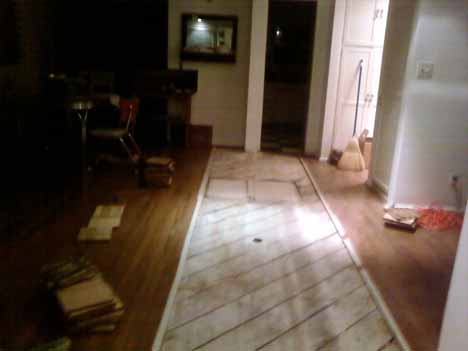
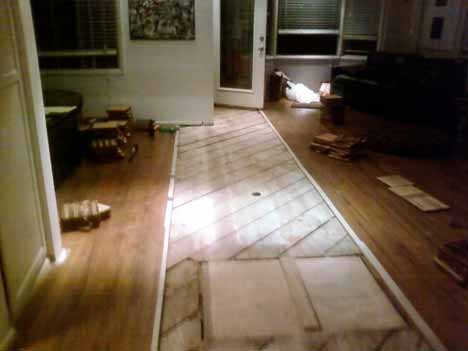
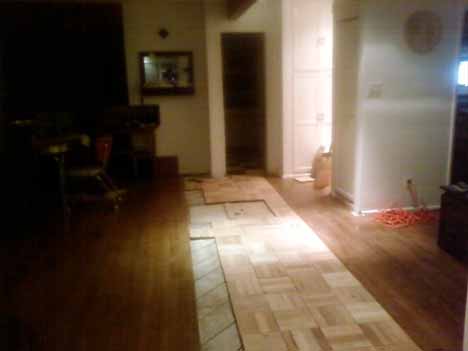
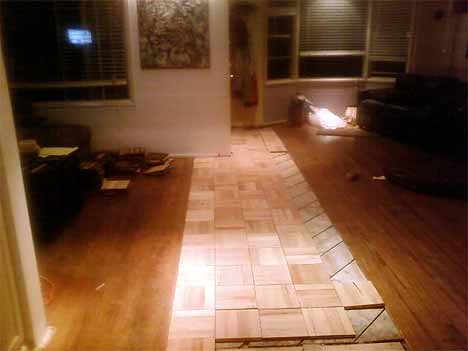
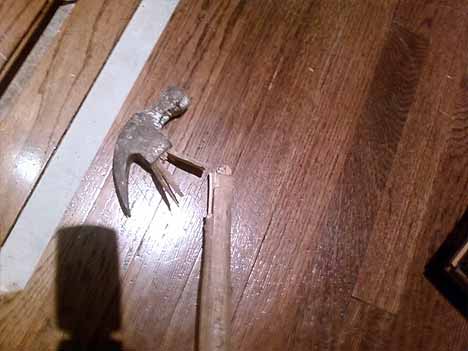
You enjoy your Cinco de Mayo last night? I spent mine partying with my friends: a hammer, a crowbar, Led Zeppelin, and Tecate. Lots of Tecate. Working past midnight, I threw myself into the task of pulling up the existing twenty hardwood strips and clearing the way for the Binary Floor. I was pleasantly surprised by how much I accomplished once I got moving. The more I do this stuff, the more I realize I’d probably be a carpenter in another life.
Below is a test layout. Next step is to do some precise math, figure out what needs cutting, and start getting busy setting, sanding, staining, and finishing.
Update: I’ve decided that the binary sequence will begin at the kitchen, working its way to the front door. That is, 00001 will be at the kitchen’s threshhold.
Special thanks to Hector for some direction, a loaned crowbar, and the finishing touches we plan to get to as soon as this weekend.

I read a book called Wordplay this weekend, by graphic artist and typographer Professor John Langdon. Langdon’s best known for his mastery of the ambigram, sometimes called an inversion, which is a graphical figure that spells out a word identically from more than one orientation, typically rotationally or reflectively. Langdon became quite a figure in pop culture through his association with Dan Brown, author of The Da Vinci Code and Angels & Demons, stories which not only include ambigrams and symbology as integral elements of their plots, but include the protagonist Robert Langdon, whom Brown named so as an homage to John.
Can’t say enough good things about Wordplay, an absolute must-read. Langdon taps into incredible realities that tickled every corner of my brain. It’s the type of read that people would describe as “life-changing”, although this one was more of a sort of confirmation than a revelation. It’s as if what he’s pointing out isn’t really anything new to me; it’s an awareness that has always been there, a layer or two below my consciousness. Not so much eye-opening as it was brain-clearing.
Along with plenty of mind-blowing eye candy, Langdon gets into not only his mechanical technique, but a history of his influences, a list on which M.C. Escher ranks near the top. Langdon also pointed out how, while in college, he became obsessed with the yin and yang symbol and the Tao. He took his studies further than most sane people would, and his growing love for the Tao became not so much a philosophy or a belief system, but a way he sees the world and a filter through which he notices its elements. He developed a heightened awareness of the opposites in the Universe — Black/White, Life/Death, North/South, etc. — and began creating ambigrams that not only read twice visually, but conceptually.
Did I say I loved the book?
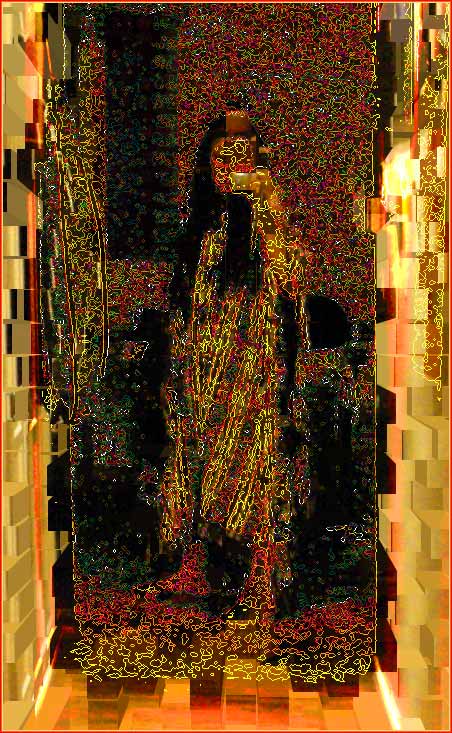
Anyway, I couldn’t help from having a whack at things myself, starting with my name. Here’s the animated version to make the ambigrammaticality* more apparent:

*Sorry, I couldn’t resist using “ambigrammaticality” in a sentence for the first time.
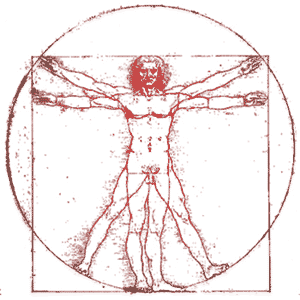
“Art is the antithesis of science. They are fundamentally different. The scientific method proceeds from the left hemisphere of the brain, moving methodically, each step based upon the data from the preceding step. Art emanates from the right hemisphere and, not constrained by logic, is propelled by intuition and imaginative association. Yet while their individual characteristics vary greatly, art and science are essentially the same. Each is a process involving the observation of phenomena in order to describe and understand the world around us.”
–John Langdon
As a sort of second step in the binary floor project, I spend the late morning going through about ten boxes of the wood tiles. The first couple hours involved some “weeding out”, if you will: picking the best ones, tossing the rejects. Since I already knew my math, 5 x 32, I picked the best 160 or so and set ’em aside. By the time noon rolled around, I ate a sandwich, and moved on to step three: cleaning.
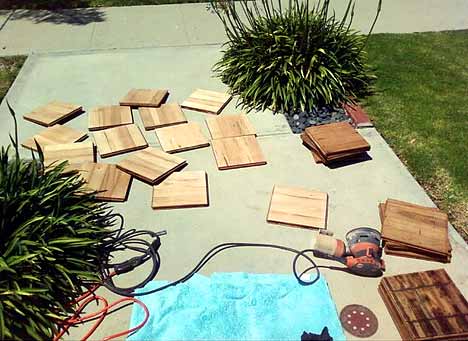
Most of the 160 tiles were coated with about sixty years of cat shit, baby vomit, and the black tarrish glue that had they’d been set in originally since the fifties. While I could’ve used up plenty of elbow grease taking the stuff off with mineral spirits, I instead decided to break out the rotary sander and do a semi-quick sanding of my chosen 160, with the intention of laying them down for a final sanding, staining, and finishing. I got myself all set up by way of extension cord out in the front yard.
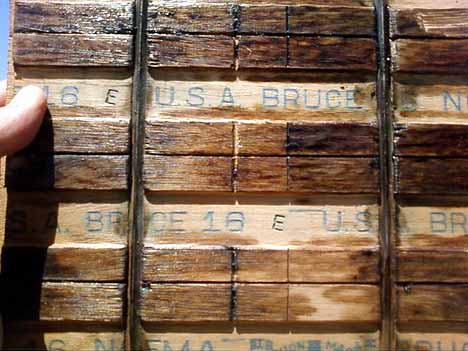
Here’s the underside of one of the tiles showing the Bruce U.S.A. stamp:
I started getting my system down within an hour. Here’s the thing: while many of the tiles were fairly clean, a ton of them were coated with heaving drops of tar/glue. Since my chosen method of cleaning was the sander, I ended up needing to budget my sandpaper. The trick was to make two piles of tiles: 1) tiles ready for the final sanding, and 2) tiles with heavy glue stains. To conserve paper, I found a method where I took all the heavy stained pieces, gave ’em a quick sand to loosen the glue, and set ’em aside for a final sanding. After the final sanding, I’d wipe off the dust. A random moment:
The process became a combination of utter mechanical boredom and Zen, with A Perfect Circle rolling in the background and the sun beating down on my back. The drill was, loosely, working in about groups of twenty tiles, sand, wipe off, let dry in the sun, sand some more, pick up the dry tiles, box ’em and take ’em to the house, box the now dry tiles, take ’em to the house, take more tiles outside, sand, wipe off, repeat. And then repeat again. Indefinitely.
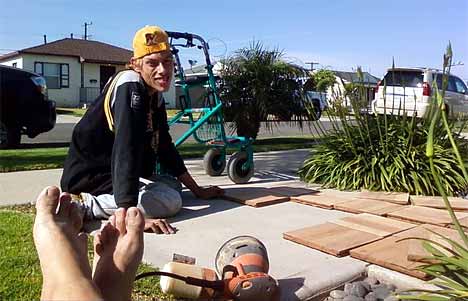
It wasn’t long until a guy came walking slowly up on the sidewalk. I’ve seen him in the neighborhood before. Many times. He lives around the block, and when I drive by in the morning with the dogs he’ll be sitting out on the sidewalk in front of his house, waving to me.
He comes walking up, struggling, with the aid of a contraption you might call a walker. Donned in a Kobe Bryant Lakers jersey and matching hat, he utters words that I don’t understand at first.
“What’d you say?” I ask.
He replies, slowly. Paying close attention, I can understand him. “What are you doing?” he asks.
“Just doing work around the house,” I tell him, not particularly interested in small talk. “Fixing my floor.”
“Can I help?” he offers.
I’m thinking, this has got to be the sweetest thing anybody has ever said to me in weeks. Hell, why not.
“Sure,” I say. “Have a seat.”
My new friend plops himself down there in my yard amongst the stacks of tiles that comprise my unfinished work. I’m thinking, what timing. He’d be a great guy to take care of the wiping down part. Right?
“What’s your name?” I ask.
He answers, slowly and carefully, “Derek.”
“How do you spell that, Derek?” I ask. Because, you know. I need to know that stuff.
“D-E-R-E…” he struggles.
“D-E-R-E-K?” I conclude.
“Yeah,” he smiles.
“Cool, Derek. I tell you what. Don’t move.”
I walk into the open front door of the house, through the living room towards the kitchen. I grab one of my biggest pots, another rag, and a beer. Filling up the pot with water, I return to the front yard. Derek’s still sitting there.
“You can wipe the tiles after I sand ’em,” I explain, setting the pot of water next to him.
“Okay,” he gleams. As if I just told him he’s won the lottery.
And so we worked. For a good couple ours or so. I’d sand, Derek would wipe. I’d sand, Derek would wipe. And he’d get it all, too. I’ve never seen anybody wipe wood tiles so thoroughly, and with such enthusiasm. Every twenty minutes or so Derek’s pile of clean tiles would be a few feet tall. I’d consider this a sign to take a break, and would stand up, stretch my legs, move the tiles to the house, and maybe grab another brew. Derek would just sit there, waiting for more instructions.
We continued this for about a hundred tiles. In the sun, in our own worlds, yet sharing this one special world of sanding tiles, wiping the dust off of them, and putting them in a pile.
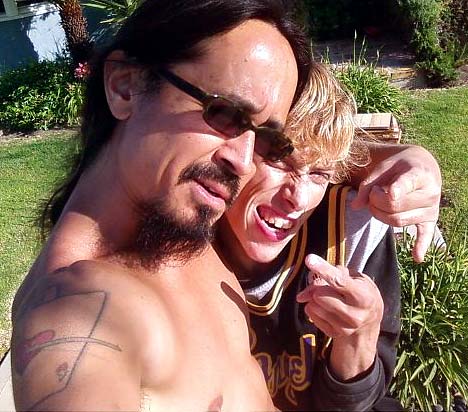
Derek lives with his mother, and claims to be a computer operator for the Port of Los Angeles. His birthday is October 26th, and will be twenty-one this year. He also loves the Lakers, and is convinced that Kobe will be MVP.
Thanks for your help, Derek!



It’s happened. As a follow-up to the New York Times Bestseller, SMITH Magazine has announced a new six-word book: Six-Word Memoirs on Love & Heartbreak, scheduled for release by Valentine’s Day, 2009. This one gets personal, and, as we’ve logically expected from subsequent volumes, themed.
Wanna play? It’s the same drill as last time: go share your six-word love & heartbreak story on the smithmag.net site and, who knows, you could be in the next book.
This one was sort of a deja vu for me. In a wave of inspiration that was almost identical to the original 2006 contest, the obvious flowed through my fingertips before they even touched the keyboard.
In related news, word has it that SMITH is adding 100 new six-word memoirs to the expanded, hardcover edition of the six book, most from the original Twitter SMITHmag followers.
Wherein we describe W’s tenure as president, now that it’s (almost) finally over.
—sixwordsforbush.com
Okay laugh lovers, you’ve gotta take some time to surf through someeecards.com. A celebration of sharp satire and irony, pairing old illustrations with punchy captions. Tip: Spend a few seconds looking at each illustration before you read its caption. Brilliant stuff. My ribs hurt right now.
And if you’re down with the sport, follow them on Twitter.
An overview of the desktop publishing revolution, including some of the big software players, some technical information, and a brief timeline of publishing dating back to 25,000 B.C.
The Final Jeopardy blog posts a video clip of the show’s final question every day. Cool.