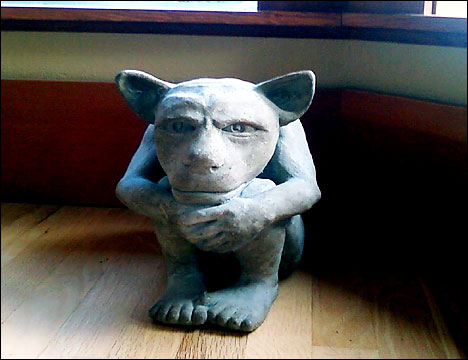
The housesitter. Shot at Larry and Pat’s place on the Puget Sound up in Bellingham, WA.

The Open Book
by Jace Daniel (b. 1969)
There once was a book on a shelf. This book was unlike any other, and for many years sat quietly on the shelf, closed, with all its pages hidden from view behind its hard cover.
One day, the book became bored with being closed. Desiring something new, it took itself off the shelf, found a clear spot on the table, and opened itself up to the world, revealing its written words, sentences, and paragraphs. Its pages became free to turn by all who found them interesting. The book soon learned that the less it had to hide, the more comfortable it was with its place in the world.
Before very long, a pair of reading glasses, who had been regularly visiting the book’s pages, approached the book. “I don’t know how you do it,” the reading glasses said.
“What do you mean?” asked the book.
“You’re giving the world all your information,” said the reading glasses. “For free.”
“How so?” asked the book.
“Everything written on your pages is there for the world to see,” said the reading glasses. “And quite honestly, it can be too much information.”
“How so?” asked the book.
“Well,” said the reading glasses, “Allowing others to freely flip through your pages and know everything about you can be dangerous. If you let them know everything about you, they may misread you, and they’ll draw their own conclusions.”
“Is that a bad thing?” asked the book.
“It can be,” said the reading glasses.
“But why should I spend time caring about somebody who would choose to jump to conclusions about me?” asked the book. “It’d be better not to have met them at all.”
“I’m just saying it can be dangerous,” said the reading glasses.
“And do you know everything about me?” asked the book.
“Indeed I do,” said the reading glasses.
“How so?” asked the book.
“I know everything about you because I can read,” said the reading glasses. “I’ve read everything written in your pages. Every word, every sentence, every paragraph, every chapter. From cover to cover. You’re an open book. There’s nothing I don’t know about you.”
“Ah,” said the book. “But that’s simply not true.”
“How so?” asked the reading glasses.
The book laughed at the obvious.
“Not everything in a book is written.”
From our nosebleed seats at Dodger Stadium on October 4th, 2008, here’s the final out and the beginning of the celebration as the Dodgers sweep the Cubs in three games to advance to the National League Championship Series for the first time in twenty years. What a night. Sorry about the shakiness; I was hugging my dad and bros.
Champagne-soaked October baseball in Los Angeles hasn’t happened since we won the World Series in 1988. Something special is happening in this city right now, and we’re all excited to watch it all unfold. Buckle up!
*UPDATE*; a couple more courtesy of Jedster: [click to continue…]
Back in 1995, I was one of the people who parked a television in the office and followed every step of the Orenthal James Simpson trial. From the opening arguments on a cloudy February morning to about 10:18AM PST on the morning of October 3rd, I had the trial on, playing it like background music.
Any thinking person who followed that trial without perverted bias found the verdict — which was reached in a suspiciously brief period of a couple hours — to be pathetic, disheartening, and otherwise completely laughable if it weren’t for the very real horror of what happened to Nicole Brown Simpson and Ron Goldman on June 12th, 1994. The nauseating icing on the cake for me was the rejoicing by people who were hoping for a Not Guilty verdict. I’ll never forget the stomach-turning display of pleasure we saw from OJ supporters. It was clearly rooted in an agenda that had nothing to do with facts, and had everything to do with racism and a misdirected desire for payback after the Rodney King trial a few years prior. Just sick.
That day, October 3rd, 1995, was a big day for me. I’ll never forget it. A warm, early Fall day at Warner Bros. in Burbank. I lost a lot of faith in our justice system that day, almost put my foot through the television screen, and became deeply cynical in several areas. Not only with the system, but with the human race. I concluded that common sense was overrated, and that our system of “trial by a jury of peers”, while admittedly a theoretically better system than any other, is fundamentally flawed simply because it overestimates human intelligence and turns the corrupt manipulation of impressionable minds into a monetizable sport. I don’t think I ever viewed the world quite the same again after that morning. I also took myself off the grid when it came to sensationalized media coverage of current events.
But here we are, thirteen years later, and, well, justice works in mysterious ways.
October 3rd, 1995: ACQUITTED
October 3rd, 2008: CONVICTED
Ain’t karma a bitch?
Who and that are used when referring to persons. Select who when the individual person or the individuality of a group is meant and that when a class, species, or type is meant.
- She is the only one of my managers who can speak Japanese fluently.
- He is the kind of student that should take advanced basketweaving.
Which and that are used when referring to places, objects, and animals. Which is always used to introduce nonessential clauses, and that is ordinarily used to introduce essential clauses.
- Laura’s report on employee benefits, which I sent you last week, should be of some help. (Which introduces a nonessential clause – there is only one report.)
- The report that I sent you last week should be of some help. (That introduces an essential clause – there may have been other reports sent in other weeks.)
NOTE: Many writers now use either which or that to introduce an essential clause. Indeed, which is to be preferred to that (1) when there are two or more parallel essential clauses in the same sentence, (2) when that has already been used in the sentence, or (3) when the essential clause is introduced by an expression such as this…which, that…which, these…which, or those…which.
- Vivian is taking courses which will earn her a higher salary rating in her current job and which will qualify her for a number of higher-level jobs.
- That is a movie which you must not miss.
- We need to reinforce those ideas which were presented in earlier chapters.
Which, that, and who may be used to refer to organizations. When you are referring to the organization as a single entity (in other words, as it), then use which or that. However, when you are thinking of the organization in terms of the individuals who make up the organization (in other words, when you think of the organization as they), you may use who or that.
- Although you are free to choose your own doctor, medical care is also available through an HMO [a health maintenance organization] with which the company has a special contract. (Since the HMO is referred to as a single entity, use with which, not with whom.)
- Whenever we run short of computer supplies, the Brown and Weiner Company is the one that gives us the best service and the best prices.
- We really like doing business with the people at the Brown and Weiner Company. They are a customer-oriented group who give us the best service and the best prices. (That may also be used in this sentence in place of who.)
Source: The Gregg Reference Manual.
Four guys are playing golf when a funeral procession drives by on the road alongside the golf course. The first golfer drops his club and says, “Hold on, I’ll be right back.” He runs to the top of a nearby hill, takes off his hat, and bows his head for a full five minutes as the cars drive slowly by. When the final car passes, he puts on his hat and trots back down the hill to the rest of the foursome.
“What was that all about?” ask the other golfers.
“It was the least I could do,” explains the first golfer. “We were married for forty years.”

Man dives in to save dog from Fla. shark attack
Jake the dog is recovering after his owner dove into the water to save him from a shark. =full story=
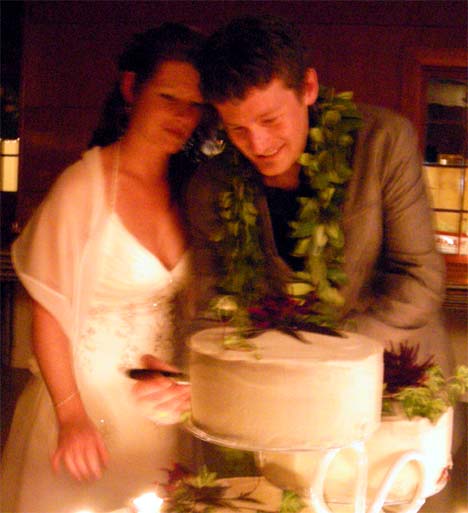
My cousin Amos (his dad and my mom are brother and sister) married his Jennifer at the Canadian border this weekend, right under the Peace Arch. She’s from Canada, he’s an American, and now they’ll be embarking on an exciting journey as they relocate to Australia.
A few of us on the groom’s side of the family flew up to Seattle on Friday with strategically coordinated arrival times, and then drove up to the bash in one car. There were a couple misadventures along the way, but I’ll save that for another time. For now, some photos.
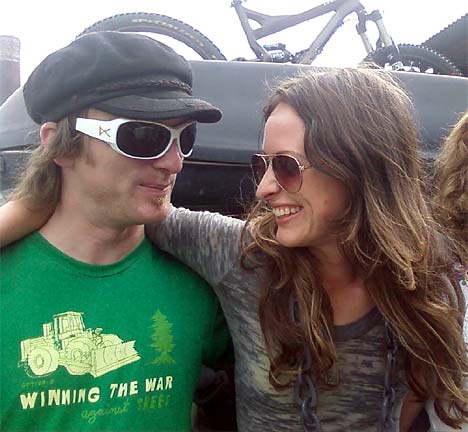
↓ Cousin Will (Aim’s brother) and Cousin Erin (our moms are sisters) in the brewery parking lot after picking up a keg of Manny’s Pale Ale in Seattle.
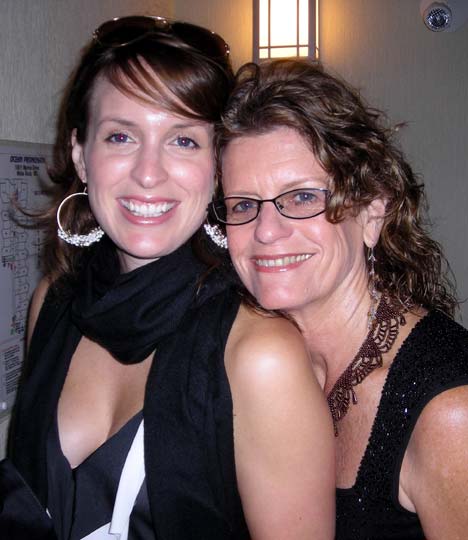
↓ Cousin Sarah with her mom, my Aunt Joanne a.k.a. “Jar” (my mom’s sis).
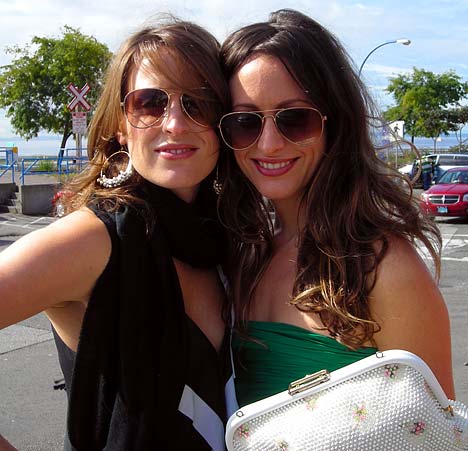
↓ Hotties.
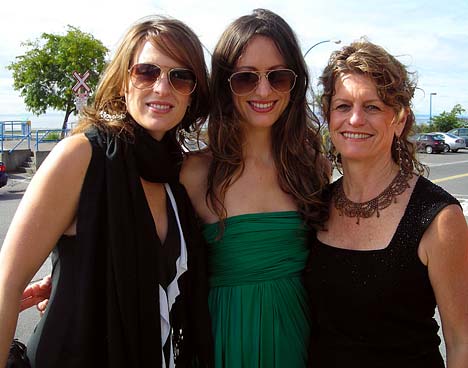
↓ Sisters with their mom.
↓ With Jar. As we crossed the border with US passports and birth certificates, it dawned on us that, besides Jamie and Ash, we’re the only two from the Freeman clan that were born in Hawaii.
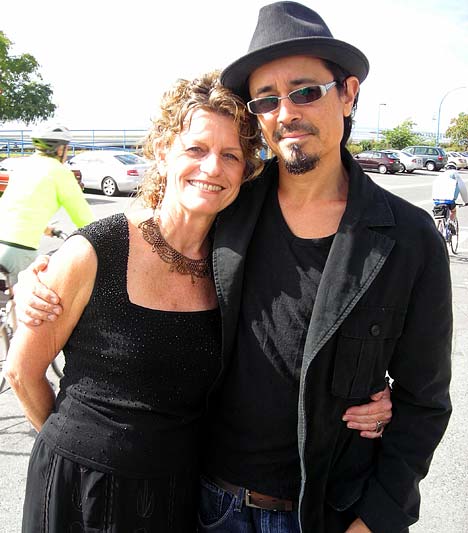
↓ Ain’t gonna lie to you. Being related has its disadvantages.
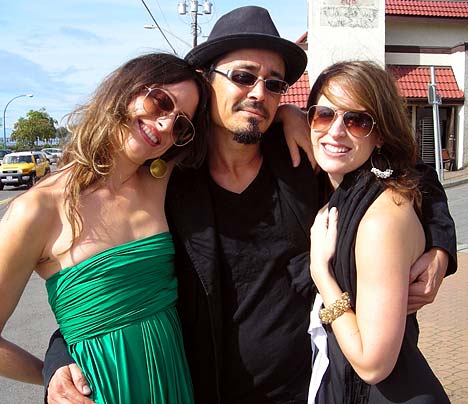
My cousin Amos and his new girl Jennifer got married this weekend on the Canadian border, just a couple days before they relocate to Australia. Five of us (Will from Portland, Sarah from DC, Joanne from Albuquerque, Erin from San Francisco, and myself from Los Angeles) hooked up in Seattle on Friday and drove up. We all coordinated our flights to arrive at around the same time.
My Southwest flight from Los Angeles had a quick stop in Oakland, where my cousin Erin boarded the plane for the Seattle connection. We were essentially arriving in Seattle on the same flight.
Our Sunday night flight home out of Seattle was also the same. Erin and I had figured we’d just wing a transportation solution from Canada back down to Seattle, either by hitching a ride, finding some sort of public transportation, or just renting a car. Waking up late Sunday pretty much erased the first two options, so we rented a car at an Avis in White Rock and headed out at about 12:30 PM. That’d give us plenty of time, with perhaps even allowing us a couple extra hours to have some drinks in town.
Then we hit the Canadian border, which was in the middle of some sort of memorial service. The main gate to the US was closed, and they sent us on a detour. The traffic was horrendous, and were in line, in an idling rental car, for almost three hours. By the time we reached customs, it was 3:11, with an estimated time of about two and a half hours to the Seattle/Tacoma airport. Provided there was no traffic.
We hauled, doing our best to distract ourselves from the quiet stress of possibly missing our flight. I knew that if we hit traffic in Seattle, we’d have a serious problem.
But we made it by the skin of our teeth, arriving just minutes before departure. I broke out my dying cell and rolled a quick clip of two very tired cousins after a long travel day.
Our moms are sisters.
And. Retain and before the last item in a series, even though that last item consists of two words joined by and.
- We need to increase our expense budgets for advertising, staff training, and research and development.
(NOT: We need to increase our expense budgets for advertising, staff training, research and development.)
Beginning a sentence with and or some other coordinating conjunction (but, or, or nor) can be an effective means–if not overused–of giving special attention to the thought that follows the conjunction. No comma should follow the conjunction at the start of a new sentence unless a parenthetical element occurs at that point.
- Last Friday George promised to submit the market analysis this Monday. And then he took off on a two-week vacation.
- Tell him to return to the office at once. Or else.
BUT: George called this morning from Lake Tahoe to say that the report was undergoing some last-minute changes and would be on my desk by 11 a.m. And, to my delight, it was!
NOTE: Each of the sentences above illustrates how this device can be effectively used. However, these sentences also illustrate, when taken as a whole, how quickly the overuse of this device dissipates its effectiveness.
And etc. Never use and before etc.
And/or. Try to avoid this legalistic term in ordinary writing.
Source: The Gregg Reference Manual.