“To see a World in a grain of sand and a Heaven in a wildflower, hold Infinity in the palm of your hand and Eternity in an hour.”
— William Blake, from “Auguries of Innocence”
This one caught my eye and ear. Shots of San Pedro set against an ukulele medley of “Somewhere Over the Rainbow” and “What a Wonderful World” as recorded by Bruddah Iz. It has a beautiful lull to it — a lull that tickles my Hawaiian roots — that reminds me why I love home. Anybody with an intimate familiarity with Pedro knows exactly what I mean. Some of these shots are typically spectacular.
When compound verbs in the same sentence share a common element, that element does not need to be repeated.
- We have received your letter and forwarded it to our Liverpool office. (The helping verb have is shared by the two main verbs, received and forwarded.)
- We can and will achieve these goals. (The main verb achieve is shared by the two helping verbs, can and will.)
However, do not omit any element when different parts of the main verb are required.
- wrong: I never have and I never will forget what you have done for me.
- right: I never have forgotten and I never will forget…
- wrong: We have and still are asking for an accounting of the assets.
- right: We have asked and are still asking for…
Source: The Gregg Reference Manual
Love it.
From the award-winning documentary, “Playing For Change: Peace Through Music”, comes the first of many “songs around the world” being released independently. Featured is a cover of the Ben E. King classic by musicians around the world adding their part to the song as it travelled the globe. This and other songs such as “One Love” will be released as digital downloads soon; followed by the film soundtrack and DVD early next year.
Jeff walked in this morning with a few select pages torn from the Member Drill Book provided by Veer’s underground society known as “The Secret Order of Creatives Understanding”. A soft copy is available online. The drill book includes various exercises to spark your creativity.
As described by Veer:
Member Drill Book
The Very Secret Order of Creatives Understanding exists for the sole purpose of encouraging and celebrating creativity at every opportunity. Since you create wonderful things, you’re a member. No reference checks. No humiliating hazing -– unless requested.
This drill book will help you keep your creative muscles flexed and ready. Ripped even. Think of it as a health club for your mind. The drills are the equipment (no need to wipe them down after using). The blank spaces are a big, wide-open gymnasium — perfect for big, new ideas. And murder ball. However, no part of this drill book is a sauna. Darn.
Here’s the first exercise Jeff challenged me with. Examine the three images, let the ideas fly, and write a piece of copy that sums it all up:
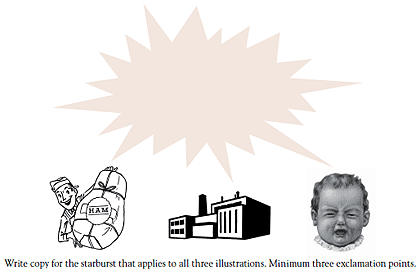
Cool! Try it yourself first. Take your time to brainstorm. Then, if you’re interested, here’s what I came up with: [click to continue…]
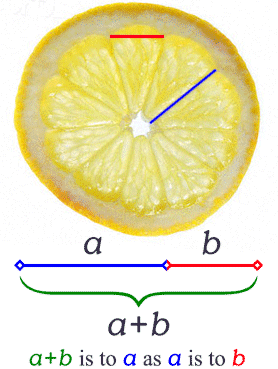
It will never be a secret that I’m in rabid love with the Golden Ratio Line, the Fibonacci Sequence, and other magically delicious morsels of mathematical awesomeness. It’s a topic of conversation that I’ve had many times with anybody interested enough to humor me, or, at the very least, gracious enough to pretend they’re interested.
One of those peeps is my old bro Mike Foster a.k.a. Left Dog. I just got the following Facebook message from him yesterday:
December 8 at 12:13pm
So here I am, cutting a lemon in half. Done this thousands of times. This time I begin to notice the natural symmetry of the (for lack of better illustrative example), the pizza pie shaped pieces. And what does my mind wonder? Whether or not the ratio from the outer parts of the slices closest to the rind (where the “crust” would be in a pizza) to the side walls of the slices moving towards center are another example of the golden ratio. Somewhere in the 1:1.618 realm. And damn it if ain’t somewhere near there.
Well, damn indeed. I grabbed a photo of a lemon slice and measured the thing in Photoshop. I kid you not, Mike is SPOT-ON. The math for the two segments was 52 pixels and 84 pixels, respectively. Above is a visual to make it more apparent, where a = 84 and b = 52.
Calculate it!: 52 x 1.618 = 84
This lemon example is by no means unusual; you’ll find the 1:1.618 thing everywhere once you start paying attention. It’ll actually get to the point where the challenge is not noticing it. In everything. You can’t turn it off. Once that happens, just give up. It’s no use. Take it from me; it’s got you for life, and you might as well surrender to it. It’s who you are. It’s what we are. Literally. I mean, have you ever analyzed the relative lengths of the bone segments between the joints of our fingers? 😉
(thx, LD)
Written and directed by PES, this masterpiece is a 2009 Sundance Official Selection and was named by Time as one of the Top 10 Viral Videos of 2008. From Time:
Filmed in stop motion, Western Spaghetti is a clever cooking simulation, an arts-and-crafts extravaganza that manages to make bubble wrap look like boiling water and lets red velvet fill in for tomato sauce. The ingeniously inedible meal is the work of Adam Pesapane, 35, a digital artist in New York City who goes by the nickname PES. For more of his self-described twisted creations, check out PES’s site at eatPES. It’s truly magical.
And that it is. Trip out:
Found this:
While researching this question, we happened upon a word that made us feel old: vintage. It’s hard to believe that our trusty math buddy is now considered vintage machinery.
According to Vintage Technology, both buttons are a way to clear or cancel an entry. The C button will clear all input to the calculator. The CE button clears the most recent entry, so if you make a mistake in a long computation, you don’t need to start all over again.
Exactly when calculators began to use these buttons is hard to say. The Vintage Calculators Web Museum provides a timeline that seems to show that the Friden EC-130, which was introduced in 1964, included “clear entry” and “clear display” keys (as did its successor, the EC-132). Those may not be the exact C and CE keys we see today, but it sounds like they performed the same function.
Our nostalgia for the calculator led us to check out even older models — just for fun. The futuristic sounding Comptometer, invented in 1884, definitely wouldn’t fit into a pocket. And it looks like you could catch your tie in the 1874 Odhner. We’ll stick with the credit-card-size models. They’re less of a load.
Source: ask.yahoo.com
Here’s an example offered by a user that was voted most helpful by the Yahoo community:
CE is Clear Entry, s o if you type 5 * 3 CE it only clears the entry of 3, the 5 * is still there, so if you type 4 = it’ll show 20.
C is Clear everything, so if you type 5 * 3 C then it’s all gone, typing 4 = will display 4.
Via Time, the Top 10 Viral Videos of 2008.
Don’t miss #3, Christian the Lion. (Audio — ahem — not necessary.)