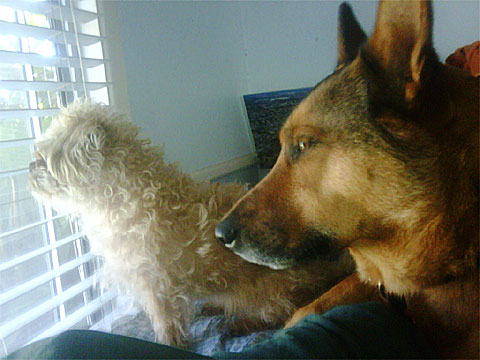
My babiest sister Heather is twenty years younger than me. We never lived in the same house. We called each other Bub.
I lived a couple hours away from the family by the time Bub was born, so my main method of communicating with her was by regular phone calls. In the early nineties, during her toddling years, I must’ve spent hundreds of hours on the phone with Bub. To keep the conversations interesting, I would intermittently “hand the phone” over to some of our favorite Sesame Street characters, namely Grover, Oscar, Bert, and Ernie. My vocal impersonations of these four friends are admittedly not bad, and Bub bought the whole thing. She seriously thought they were all hanging out at my apartment.
I just heard from Heather this morning. She’s captured some video footage I’d never seen and uploaded it to YouTube. She looks to be about two years old in this footage, which puts us somewhere in about 1991.
How long Anand will remain champion is another question. He is 40, an age when chess players usually begin to decline. Last year, Kasparov said in an interview with Mail Today that he thought Anand could not hold onto the title much longer. “He is up against people half his age,” Kasparov said. “I will be surprised if he can go on any longer. He can fight against anyone but time.” Looming on the horizon is Magnus Carlsen of Norway, the No. 1 ranked player in the world, who is only 19. Most people, even Anand, have said that they expect Carlsen to become world champion one day.
I think I might’ve shed a tear on a few of these beautiful photos by London’s Nick Brandt.
Check out the whole gallery here. From the artist’s bio:
Few photographers have ever considered the photography of wild animals, as distinctly opposed to the genre of Wildlife Photography, as an art form. The emphasis has generally been on capturing the drama of wild animals IN ACTION, on capturing that dramatic single moment, as opposed to simply animals in the state of being.
I’ve always thought this something of a wasted opportunity. The wild animals of Africa lend themselves to photographs that extend aesthetically beyond the norm of 35mm-color telephoto wildlife photography. And so it is, that in my own way, I would like to yank the subject matter of wildlife into the arena of fine art photography. To take photographs that transcend what has been a largely documentative genre.
Aside from using certain impractical photographic techniques, there’s one thing I do whilst shooting that I believe makes a big difference :
I get extremely close to these very wild animals, often within a few feet of them. I don’t use telephoto lenses. This is because I want to see as much of the sky and landscape as possible–to see the animals within the context of their environment. That way, the photos become as much about the atmosphere of the place as the animals. And being that close to the animals, I get a real sense of intimate connection to them, to the specific animal in front of me. Sometimes a deliberate feeling that they’re almost presenting themselves for a studio portrait.
Why the animals of Africa in particular? And more particularly still, East Africa? There is perhaps something more profoundly iconic, mythical, mythological even, about the animals of East Africa, as opposed to say, the Arctic or South America. There is also something deeply, emotionally stirring and affecting about the plains of Africa – the vast green rolling plains punctuated by the graphically perfect acacia trees.
My images are unashamedly idyllic and romantic, a kind of enchanted Africa.
They’re my elegy to a world that is steadily, tragically vanishing.
Jace D’s Worldwide Website is a completely mental product. It is made from pure lateral thought processes, distilled ideas, and 100% whole natural bits: past, present, and future.