Under Angels
by Jace D. Albao (b. 1969)
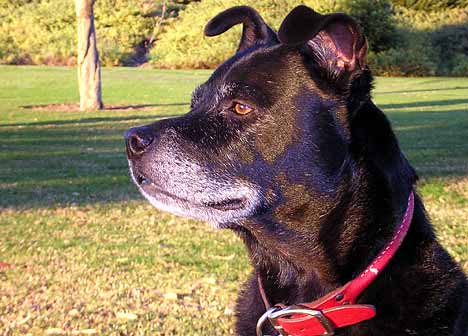
My father’s name was Dash. Black and tan and just over fifty pounds, he wasn’t the biggest dog Pete had ever trained, but he was the best, paws down. Recognized for his valiant service to our nation in time of war, Dad was declared a K-9 Veteran of World War II and buried in our cemetery with the highest of honors.
Pete and Dad awoke on the dark drizzly hillside, keeping each other warm between two canvas tarps. Pete rubbed the thick glass face of his watch, reading it under the sky’s black glow. 23:00 on the dot. 11PM.
“Rise and shine, soldier. Time to head back.”
It was two or three years before I was born. Pete and Dad were assigned to each other in the K-9 Command Unit at Fort MacArthur, spending every hour of their shifts together, training Dad for combat situations. It wasn’t an easy program, and only the very best of us had what it took to graduate. And, luckily for me, they didn’t fix the good ones.
Like all K-9 man-dog teams, Dad and Pete were put on rigorous 24-hour shifts, from midnight to midnight, occasionally stringing two or even three shifts together one after another for extra conditioning. This demanding schedule, designed to mimic the unpredictable and unforgiving conditions of war, made it impossible to sync up with the sun and settle into a regular sleep routine. So catching a nap whenever and wherever you could was a necessary skill.
The job of these two-soul teams here at home was to patrol the coastal perimeter of the Los Angeles Harbor area at night, on foot, with important combat training exercises during the day. Pete’s job was to prepare Dad for the worst, and they both took their job very seriously. Once they were done working together and said their goodbyes, Dad had to be ready for anything. Our boys over there weren’t playing games.
Pete stood to his feet on the damp hillside and shook out the top tarp.
“Dammit–”
Pete’s arm flailed, shaking an earthworm clinging to the cuff of his sleeve. Pete could handle almost any pest: rats, spiders, roaches, ants, even snakes. But when it came to worms, or larvae, or any kind of subterranean life form, he became like a queasy little girl. The concept alone turned his stomach.
“Son of a bitch–”
Pete rolled up the two damp tarps and strapped them to his rucksack. Taking a knee with his canteen, he gave Dad a swig of water in his cupped hand and they embarked on the misty two-mile night prowl back to the base. Making their way down the muddy hillside, they reached the paved coastline road and walked in a disciplined straight line.
“Bea’s a great girl, Dash. As good as they get–”
Dad walked at Pete’s left in heel position, patiently listening to the same story for the hundredth time that day. Spending dozens of consecutive hours together creates a bond between a man and a dog that can’t be fully explained in words. Pete would tell Dad things that he’d never tell anybody. Not even Beatrice.
“I’m going to ask her to marry me…”
My Dad was a German Shepherd, but our troops came to the fort from various families including Doberman Pinschers, Rottweilers, retrievers, Chow mixes, Schnauzers, various terriers, Cocker Spaniels, and bulldog half-breeds. At the onset of World War II and immediately after the attack on Pearl Harbor, hundreds of us would be volunteered for war duty by Los Angeles citizens in response to radio calls and newspaper announcements.
Some of us that were trained at Fort Mac throughout the years had been smart enough to get out of war duty, finding fame in Hollywood. Terry, a female Cairn terrier, was recruited to play Toto in the movie The Wizard of Oz. Another one of us, Buck, was used as one of the dogs in Jack London’s The Call of the Wild. And a German Shepherd named Rin, the grandson of Rin-Tin-Tin, was one of the smartest to ever come out of our camp.
With the rocky coastal bluffs just a few hundred yards away, Pete and Dad entered the unlit upper reservation and walked across the slick courtyard, ducking into the entrance of a large concrete military facility dug into a hillside called a battery. Our batteries were equipped with heavy artillery to protect our beaches from intruders.
“Let’s get you tucked in, Dash.”
Fort Mac was typically pretty quiet by midnight, with most of the activity occurring during the daytime hours. But on this night, the halls smelled like freshly brewed coffee, with loud arguing adult voices coming from a brightly lit office just inside the battery entrance.
“What do you suppose is going on in there, soldier?”
Pete and Dad passed by the office door, walking to the end of the battery’s hall to the K-9 barracks where they’d kennel us in between shifts. Nodding to the boyish kennel guard, Pete opened latch to the gate of Dad’s kennel containing a modest cot, an empty metal bowl for tomorrow morning’s hearty meal, and a large metal bucket of fresh water that never went empty. Pete dropped his rucksack to the floor and hung the leash.
“Rest up, Dash. I’ll see you at zero hundred–”
Pete closed the latch of Dad’s kennel as another trainer’s voice echoed from down the hall.
“Jackson, vamanos mi primo–”
It was Vasquez, suited up in a dry uniform and carrying a rucksack. On his left walked his partner Jackson, another German Shepherd. Vasquez and Jackson — K-9 Command Unit 61– were just about to begin their 24-hour shift, taking over where Pete and Dad left off.
“Nobody gets through on our watch,” Vasquez said. “Not through sesenta y uno–”
Jackson was another one of the best. He and Dad both entered the war dog platoon the same summer, immediately placed in the training unit of aggressive dog soldiers to be used as weapons of war. The job demanded that they were physically fit, responsive to voice commands, not gun-shy, and able to stand their ground against assailants without cowering. Dogs that made the K-9 unit were the elite, like royalty, and treated with the highest priority. If Pete and Dad were out in the hills and Pete got bitten by a rattlesnake, they’d drive him to the hospital. If Dad got bitten, they’d fly in a helicopter.
“Durante,” Vasquez said. “Did you hear?”
Vasquez and Pete slapped hands up high.
“Hear what?” Pete asked.
“Shit just hit the fan today. Hitler’s invaded Poland.”
“Fuck–”
Our world had become a scary, unpredictable place, with threats of evil gradually making themselves known all around the globe. How exactly the United States was to fit into things was not yet clear.
“Is that what’s going on in Briefing Quarters?” Pete asked. “There must be half a dozen people in there. I saw civilians too.”
“We got a message from the Brits,” Vasquez said. “Intercepted from the Nazis. It’s encrypted.”
“The voices I heard were American.”
“Brits wired it this morning,” Vasquez said. “Parallel intel’s looking at it now.”
We would soon learn that there were some very bad people in Europe, led by a tyrant with plans to systematically execute a certain group of people. Entire families were being torn apart, their dogs left on the streets to starve. Men, women, and children were being being disposed of in ovens, the fillings from their teeth removed, their skin used for lampshades, all for something these bad people considered the final solution to a problem. It’s a problem I’ll never understand.
“Is Naylor in there?” Pete asked.
“He was earlier.”
Vasquez looked at his watch.
“We’re on, Jackson. Time to protect the world, mi primo.”
Pete walked with Vasquez and Jackson down the hard hall, stopping outside the lit office as the two headed out in to the wet night.
“Go get ‘em,” Pete said. “See you on the other side.” And look out for worms.
Pete stood at the office door. Voices still shouted, involved in some sort of collaborative debate.
“I still think it’s U.S. something,” a voice said. “U.S dog line den. Or God line den–”
“U.S. long denied,” another voice interrupted.
“Sledged union,” said another. “It’s the Soviets.”
“Dungeon slide,” said another.
What in the world? Curious, Pete stepped into the doorway and looked inside. His commanding officer Naylor stood with six people, all men and one woman, some with notepads. They were all studying two words written boldly in chalk on a blackboard:
SLEDGED UNIÖN
A baggy-eyed bald man in a plain white shirt and slacks chewed the eraser off the end of a pencil, looking down at his notepad. “Dodge sun line. It’ll be something at night. I also have delousing den–”
Pete coughed.
“Excuse me,” Pete said, stepping into the doorway. “Sergeant Durante, K-nine fifty-three, just dropping off Dash. Saw the light on–”
“Pete, hey–” Naylor turned and and pulled Pete into the office, closing the door.
“Lunged on side,” an elderly man in a plaid flannel shirt said, not noticing Pete. “Or sudden legion. I still see sudden legion. Timing–”
Naylor whispered to Pete as the rest of the people studied the board in mumbling silence, scratching down notes.
“Axis message.”
“Who are all these guys?” Pete asked, keeping his voice low.
“Cryptography experts,” Naylor whispered. “Black Chamber ordered them here from other parts of the city. Shit, I should’ve kept that door closed. My ass could get slung–”
Pete gazed at the two words on the board.
SLEDGED UNIÖN
Naylor continued, pointing to the blackboard. “They think it’s a code with the letters rearranged.”
“An anagram,” Pete said.
Naylor nodded. “Sledged union.”
“What makes you think it’s in English?”
Naylor shrugged.
Pete turned to the people and spoke up, pointing to the blackboard.
“Pardon me, but why are you looking for English words? I don’t mean to interfere.”
Stares stuck to him like magnets.
“Dungeon slide,” Pete continued, repeating the words he’d heard. “Sudden legion, dodge sun line. Those are all English words you’re coming up with–”
Pete walked to the board and tapped his fingernail against the two chalked words.
SLEDGED UNIÖN
He pointed to the two dots above the Ö.
“All your words have an O in them,” Pete said. “Legion, dungeon, union. But this here has an umlaut.”
Silence.
“It ain’t an English O,” Pete explained. “The answer probably ain’t even in English. I doubt it has anything to do with dungeons and legions.”
“That’s what I was saying,” said the woman in the corner. “I suspect it’s Germanic. Perhaps even Icelandic or Swedish.”
Pete nodded. “The umlaut gives it away. These words were intercepted from Nazi intelligence, correct? Your answer’s probably in German.”
Pete stood at the blackboard like an instructor in front of a stumped class. A man in a beige suit broke the awkward silence, holding a slip of paper.
“Sergeant…?”
“Durante,” Pete finished.
“Sergeant Durante,” the beige-suited man continued. “Do you speak German, sir?”
“A little.” Pete’s grandfather had been a first-generation American, teaching the young Pete some German during their weekends of chess and puzzle solving. “I know what it looks like written down. The two dots over a vowel indicate a mutated vowel sound.”
The suited man pointed to the blackboard.
SLEDGED UNIÖN
“Can you make anything of that? We suspect it’s an anagrammatic code of some sort. Do you know what an anagram is?”
Pete nodded, looking at the two words on the board. Letting his mind fly, he recalled the thousands of blitz chess matches and crossword puzzle contests his grandfather would make him play as a boy. If there was one thing his grandfather taught him, it was to think clearly when the pressure was on. “Stress can be harnessed,” his grandfather would say. “When correctly channeled, it empowers the intellect.”
SLEDGED UNIÖN
Pete rearranged the letters in his head, paying close attention to the Ö.
“The first thing I see is die,” Pete said, staring at the board. “D-I-E.” German for ‘the’. “Die something–”
SLEDGED UNIÖN. Pete looked at the shapes of the letters, fantasizing, shifting them upside-down and sideways in his mind. He flipped them over each other, stacking them, rolling them back and forth, shuffling them, picking them up in his hands, shaking them, tossing them in the air to let them fall where they may, looking at the results. What probably should’ve been difficult to see became obvious to him, zooming from the board into his consciousness.
“Endlösung.”
The word spilled from Pete’s mouth, pronounced with an authentically learned accent.
“Die endlösung. Sledged union is an anagram for die endlösung.”
The room fell silent.
Pete grabbed a piece of chalk and wrote two words in all caps on the available empty space of the board:
DIE ENDLÖSUNG
Pete stepped back from the board and read it to himself.
SLEDGED UNIÖN
DIE ENDLÖSUNG
“Solution,” Pete said out loud. “The final solution.”
Pete wrote three English words on the available space of the board.
THE FINAL SOLUTION
“The final solution,” Pete repeated, stepping back. “Die endlösung is German for the final solution. Does that mean anything to anybody? The final solution?”
Blank stares. The beige-suited man walked to the blackboard, taking the chalk from Pete’s hand.
“Sergeant Durante, I take it you’re stationed here?”
“K-nine fifty-three. I work with the dogs.”
The beige-suited man nodded, looking around the room of fatigued eyes.
“Are you familiar with encryption, Sergeant?”
“A little,” Pete said. “Just from puzzles and such. But it’s been a long time–”
“Have you ever worked with machines?”
“Machines?”
“Encryption machines.”
“Just pen and paper ciphers as a kid.”
The beige-suited man put his hand on Pete’s shoulder.
“Sergeant Durante, we have a special project for you.”
To be continued…
- – - – -
Go to chapter: A B C D E F G H I J K L M N O P Q R S T U V W X Y Z
- – - – -


Comments on this entry are closed.