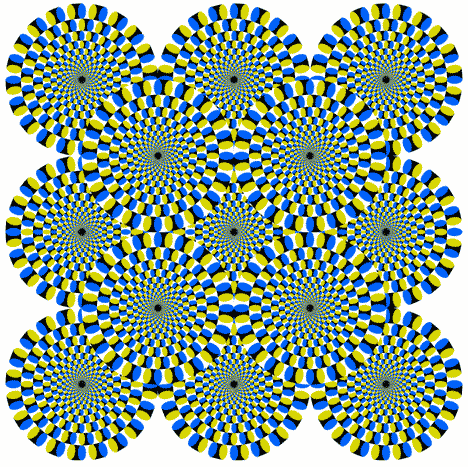
The image above is not animated; it is not moving. The rotation of the “wheels” you are perceiving is due to your own eye movements. On steady fixation, the effect vanishes.
What to observe:
Even when fixating steadily, illusory motion occurs on appearance/ disappearance Illusion does not depend on colour Rotation direction depends on the polarity of the luminance steps (they are arranged to evoke a “gearbox effect” here, by mirroring the images appropriately) Strength of illusion depends strongly on background luminance. The illusionary rotation is strongest for 50% gray; exact value will depend on your monitor’s gamma setting. Comment:
As Kitaoka & Ashida (2003) describe, asymmetric luminance steps are required. Gregory & Heard (1983) were the first to describe that asymmetric luminance steps cause illusory movement.
Sources:
Kitaoka A, Ashida H (2003) Phenomenal characteristics of the peripheral drift illusion. VISION 15:261–262
Gregory RL, Heard PF (1983) Visual dissociations of movement, position, and stereo depth: Some phenomenal phenomena. Quarterly Journal of Experimental Psychology 35A:217–237







Very matrix like. If you exercise control, do you really control the movement or lack thereof? I wonder what someone with ADHD would see. They can be intensely focused at times and other times, well, not so.
kathy